The Pitztal glacier in the Austrian Tirol opens for skiing today, joining Passo Stelvio and Val Senales in Italy to become the third skiing option in the Alps this season.



Got a burning question about weather or snow conditions in the Alps?
Contact us and we'll do our best to answer it...
Updated: – First serious snowfalls of the season in the Alps...
That’s more like it! The Alps have woken up to their first significant snow accumulations of the ‘season’ this morning, at altitude at least. It means nothing, of course, in terms of how the winter ‘proper’ will pan out, but it’s still great to see after such a torrid summer and, until recently, a very dry and mild autumn.
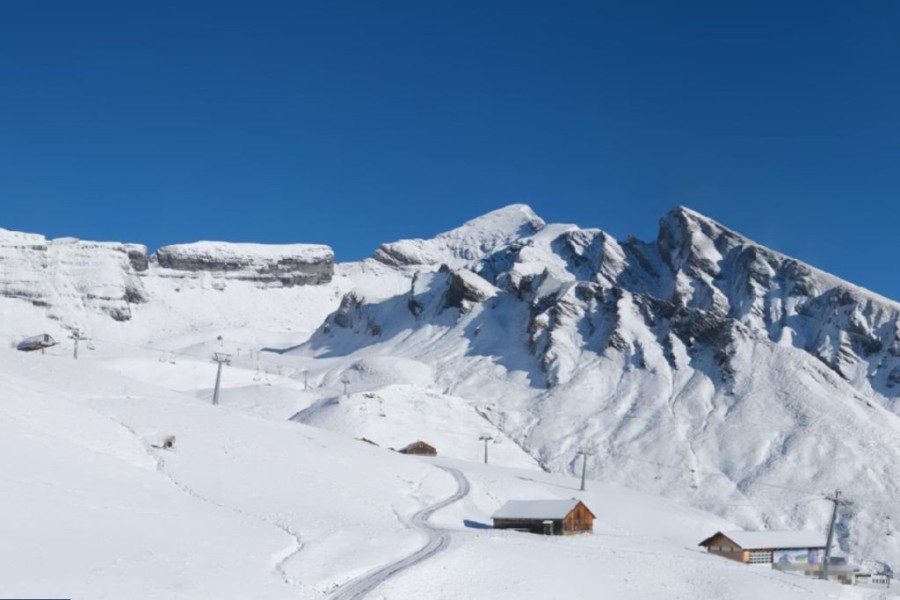 Sunny skies and fresh snow in the (not yet open) Jungfrau region this morning. This is the First sector above Grindelwald at 2166m – Photo: jungfrau.ch, 22 October 2026
This latest storm, which started on Tuesday, has affected all parts of the Alps, delivering significant accumulations of snow in many higher regions and a dusting as low as 1300m in some northern parts of the Alps late yesterday.
This is great news for the skiable glaciers, ten of which are currently open with a few more due to join the action this weekend. Snow conditions here are now excellent, with more snow forecast over the next few days.
Indeed, Friday will see another moderate snowfall across many parts of the Alps, with snow falling as low as 1200m in the northern Alps later in the day. Later in the weekend, a warm front will send the rain/snow line rise back up towards 2500m, but accumulations will become increasingly significant on the glaciers.
Updated: – Fresh snow today across many higher parts of the Alps...
As expected, the weather in the Alps has turned very unsettled, with rain or snow for most areas today.
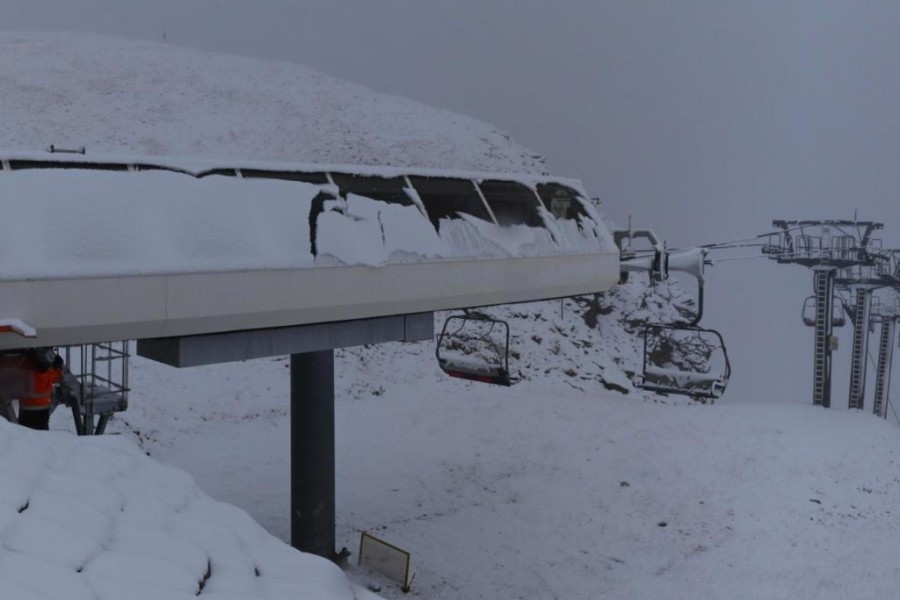 Fresh snow today on the higher slopes of the (not yet open) Val d’Isère area. This is the Borsat chair-lift – Photo: valdisere.com, 21 October 2026
At the time of writing, some eastern parts of the Alps are still dry but most of the western Alps have already seen plenty of rain or high-altitude snow, with the bad weather due to extend further east across all parts of the Alps later today.
The rain/snow limit – which was on the high side yesterday and overnight (typically 3000m) – started to lower from the west/north-west early this morning and should eventually reach 1500m across the northern side of the Alps later today. It will stay above 2000m though further south.
On Thursday, the weather in the Alps will calm down for a while before further fronts bring more rain and snow on Friday and over the weekend, but with a highly variable rain-snow limit. Stay tuned!
This very unsettled spell of weather in the Alps is excellent news for the glaciers, all of which will see significant quantities of fresh snow over the next few days. Lower down, yo-yoing temperatures mean it is too early for to make for a meaningful or lasting base, but this is entirely normal for late October.
Updated: – Significant new snowfall forecast for many of the Alpine glaciers...
The weather in the Alps is once again becoming more unsettled as slow-moving fronts push into the western Alps today. With a secondary area of low pressure forming over the Gulf of Genoa later today before drifting north-east across the Alps on Wednesday, we’re in for a complicated little period of forecasting, with the potential for some significant dumps of snow at altitude, especially across the south-western Alps.
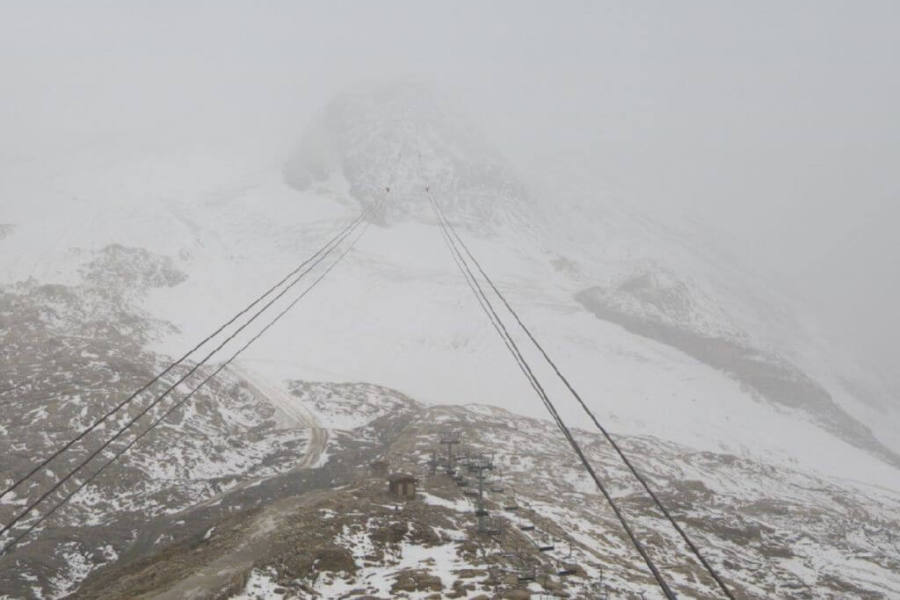 Light snow falling above 3000m this lunchtime above Tignes, where a moderate fall of snow is expected on the (not yet open) glacier over the next 24 hours, with more snow forecast later this week – Photo: tignes.net, 20 October 2026
At the time of writing, heavy rain is already falling across much of the southern French Alps and into parts of the southern Piemonte. During the rest of the day this area of precipitation will move north and east to engulf most of the French Alps, central and western Italian Alps and the southern Swiss Alps.
Protected by the Foehn, the northern Alps, will (to begin with at least) stay mostly dry and very mild, before all regions see some precipitation by the end of Wednesday.
During this period, the heaviest precipitation will fall in the south-western Alps – i.e. the southern French Alps (e.g. Isola 2000), the Italian Piemonte and eastern Aosta (e.g. Prato Nevoso, Cervinia, Monte Rosa), and the central and southern Swiss Alps (e.g. Zermatt, Saas-Fee, Aletsch Arena, Andermatt, St Moritz).
In terms of the glacier ski areas that are currently open it will again be Saas-Fee and Zermatt that will do best from this coming storm, although all glacier areas (including those in Austria which mostly missed out last time) will see a useful top-up. The rain/snow limit will start close to 3000m today but will fall to around 1500m across some northern parts of the Alps over the course of the day tomorrow.
Looking a bit further ahead, the weather will remain unsettled with further snowfalls in places later this week, possible to relatively low altitudes, at least for a time.
Updated: – Further snow forecast for parts of the Alps this week...
As expected, many western parts of the Alps saw some high-altitude snow over the weekend, but generally in more modest quantities than originally forecast. Of the 10 skiable glacier areas currently open in the Alps, Zermatt and Saas-Fee saw the most snow and are currently offering the best snow conditions in the Alps.
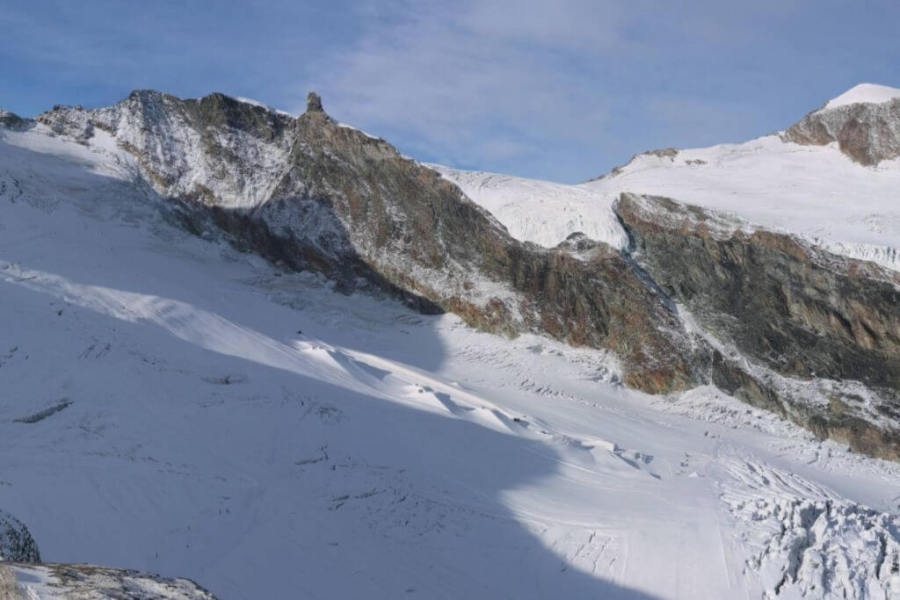 Fresh snow over the weekend has further improved snow conditions in Saas-Fee – Photo: saas-fee.ch, 19 October 2026
Over the weekend, Kaunertal finally opened its glacier for skiing, bringing the total number of options in the Alps to 10. The glacier areas currently offering the greatest extent of skiing in the Alps right now, though, are Hintertux with 21km and Sölden with 23km. While the best snow conditions are in Zermatt and Saas-Fee.
The forecast for the Alps this week is interesting but complicated, with weather fronts set to reach the Alps from the west later on Tuesday, spawning a secondary storm over the Mediterranean that has the potential to deliver some significant quantities of snow in places mid-week.
At this stage, the heaviest snow is likely to fall in the south-western Alps and close to the main Alpine ridge, again helping the Saas-Fee and Zermatt-Cervinia areas, but with snow falling more widely and to lower levels than last weekend. Another set of weather fronts is then set to arrive from the west towards the end of the week.
All in all, it looks like a positive week of weather in the Alps with fresh snow for all the glaciers, although heaviest again in the west.
Updated: – Some fresh snow for the glaciers of the western Alps!
As expected, the weather in the Alps has turned more unsettled, with some high-altitude snow in places, but generally not in any significant quantities.
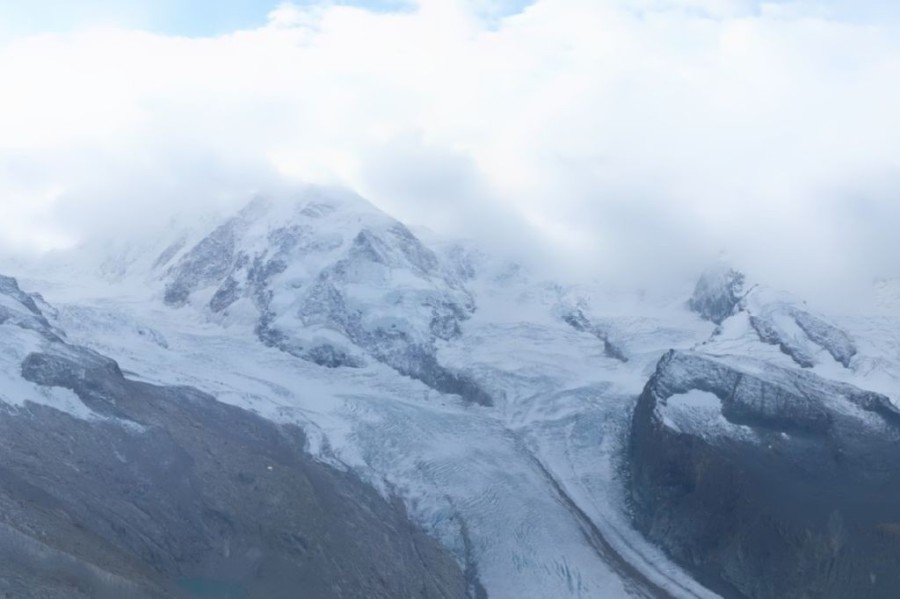 A little fresh snow at high altitude in the Monte Rosa region, with more expected later today – Photo: matterhornparadise.ch, 18 October 2026
Yesterday saw a cold front bring a few centimetres of snow at altitude to the north-western Alps (e.g. Jungfrau region, Engelberg).
Later today, most of the action will be on the southern Swiss-Italian border between the Monte Rosa and the Simplon regions. Here we could see 10-30cm of fresh snow at 3000m, which is good news for the glaciers in Zermatt and Saas-Fee, even if not as much as originally forecast. Elsewhere in the Alps, there will be very little, if any, fresh snow this weekend.
Next week, the weather in the Alps will remain changeable with some more widespread snow likely mid-week, again welcome news for the many new glacier openings expected next weekend, including Engelberg and Mölltal.
Updated: – More snow forecast for some parts of the Alps this weekend!
Following a mostly fine few days in the Alps, the weather is about to change again with some further snow forecast in some areas this weekend.
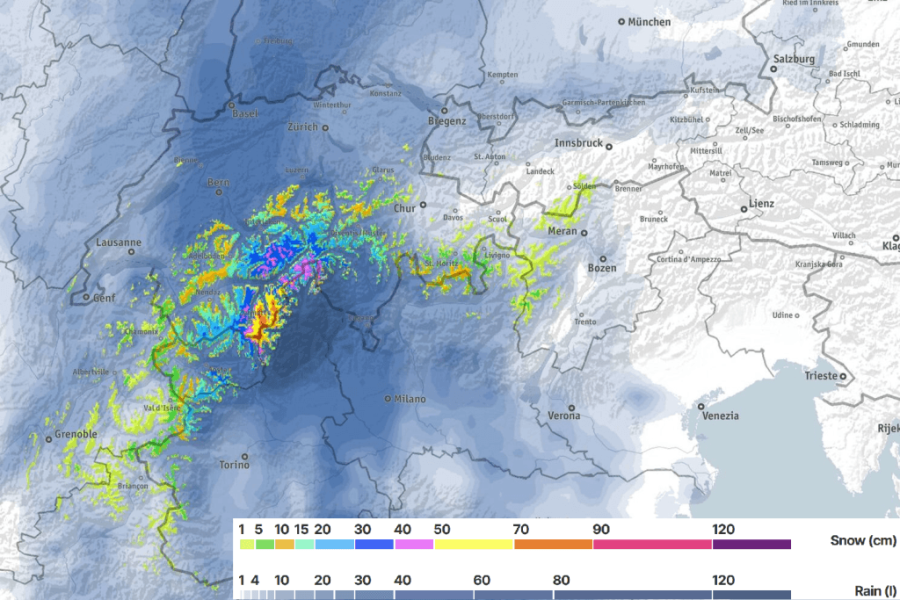 Significant but relatively localised snowfalls are forecast in the Alps on Sunday 18 October 2026 (with the biggest snowfalls indicated in orange) – Image: bergfex.com, 16 October 2026
This change of weather in the Alps will be brought about by a cold front moving in from the north-west later on , bringing a few centimetres of snow to some higher parts of the north-western Alps (e.g. Tignes, Chamonix, Jungfrau region, Engelberg) with a rain/snow limit starting at around 2600m but dropping to between 1800 and 2400m.
As this colder air reaches the still very warm Mediterranean on it will form a new disturbance that will throw moist air back up towards the southern flank of the Alps via a warm front.
The area most affected on is likely to be close to the main Alpine ridge, around Zermatt, Cervinia, Saas-Fee, the Monte Rosa region and Macugnaga. These areas could see 20-50cm of snow above 2700m between night and morning, although there remains quite a high degree of uncertainty over exactly how intense the precipitation will be.
There is even the potential for falls of 70cm+ in some of these areas if everything lines up perfectly. Of the open ski areas, this forecast snow is currently set to most favour the glacier in Saas-Fee.
Throughout this period the eastern Alps (i.e. Austria) and south-eastern Alps (i.e. Dolomites) will see little if any precipitation.
, the weather in the Alps will remain rather changeable, with bits and pieces of high-altitude snow in places, especially mid-week and in the west.
Updated: – Zermatt is now open for skiing!
Zermatt has reopened its glacier for skiing today. Only a handful of short runs are open at the top of the glacier, but it is still good news for the resort after summer skiing operations were suspended on 1 August following the relentless heat that afflicted most of western Europe.
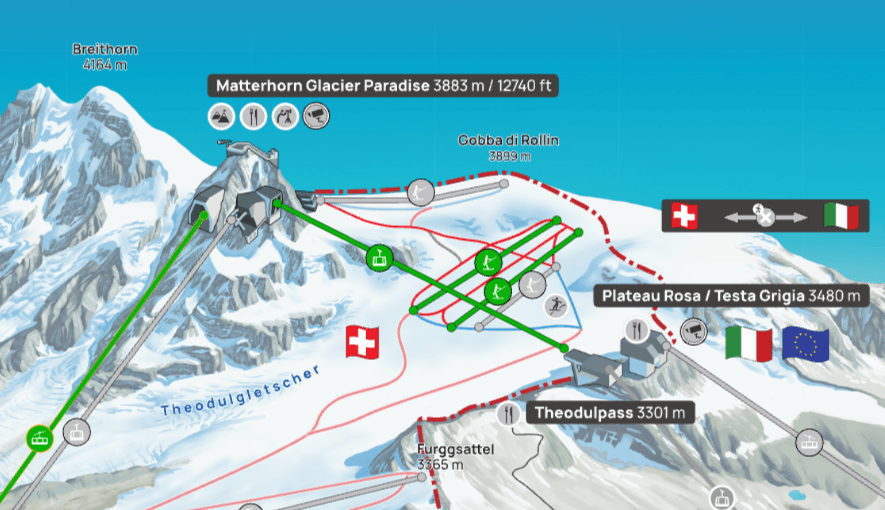 “Live” piste map for Zermatt this morning showing a small area of skiing open at the top of the Theodul glacier with access only possible from the Zermatt side of the ski area – Image: zermatt.ch, 14 October 2026
Since Hintertux was forced to start taking a summer break from skiing 2025, Zermatt is now the only glacier ski area in the Alps that attempts to open 365 days a year. However, this year, for the first time in the skiing era, there was no summer skiing in the Alps at all between 15 August and 4 September.
This morning, Zermatt’s “live” piste-map shows a small area of skiing open at the top of the Theodul glacier served by two surface lifts and the Plateau Rosa–Klein Matterhorn Gondola, with access only possible from the Zermatt side via Furi and Trockener Steg.
The opening of Zermatt’s Theodul glacier today makes it the ninth ski area in the Alps to open this autumn. Some snow helped freshen up conditions on the Alpine glaciers last week, but snow levels remain very low overall.
A little new snow may fall in places this weekend but, broadly speaking, there is no significant snow forecast for the Alps any time soon.
Updated: – More snow for the glaciers in the Alps!
A few more centimetres of snow fell across many higher parts of the Alps yesterday, adding to the snow that fell on Thursday and making for some relatively decent snow conditions in the 8 glacier ski areas that are now open.
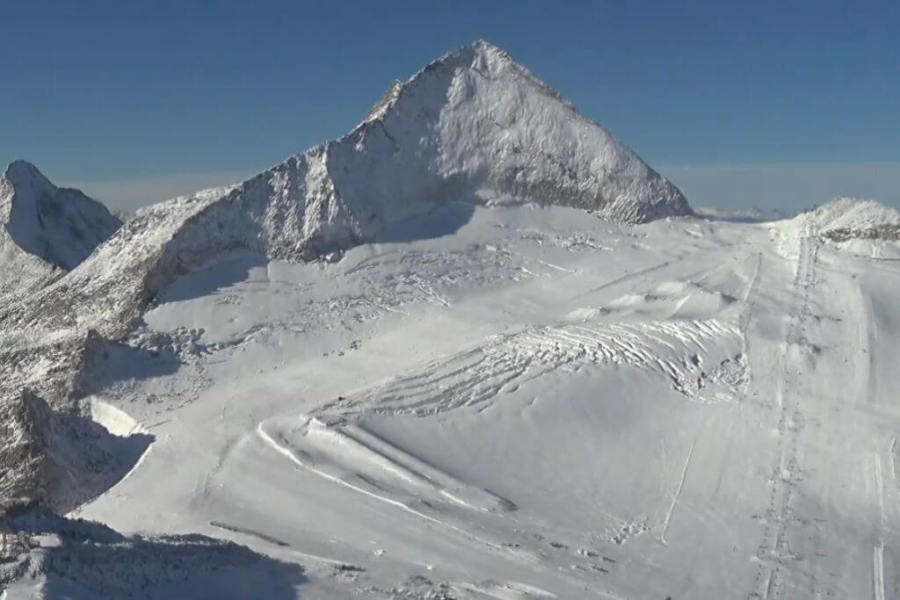 Fresh snow and relatively good snow conditions on the Hintertux glacier this morning – Photo: hintertuxgletscher.at, 11 October 2026
Most of the skiing in these areas is still very limited in extent, although Hintertux – traditionally one of the best options at this time of year – now has 18km of pistes open, albeit still on a very modest 10cm base.
So right now, in Austria, it is possible to ski in Hintertux (18km pistes), Sölden (6km), Stubai (5km), Kaprun (4km) and Pitztal (2km). In Italy you can ski in Passo Stelvio (3km) and Val Senales (1km), while in Switzerland you can ski in Saas-Fee (10km).
As we move into next week, the weather in the Alps will turn more settled and a bit warmer again, meaning that any lower-lying snow will quickly melt.
Updated: – Kaprun opens for glacier skiing today!
The Kitzsteinhorn glacier in Kaprun opens today, becoming the eighth skiing option in the Alps this season.
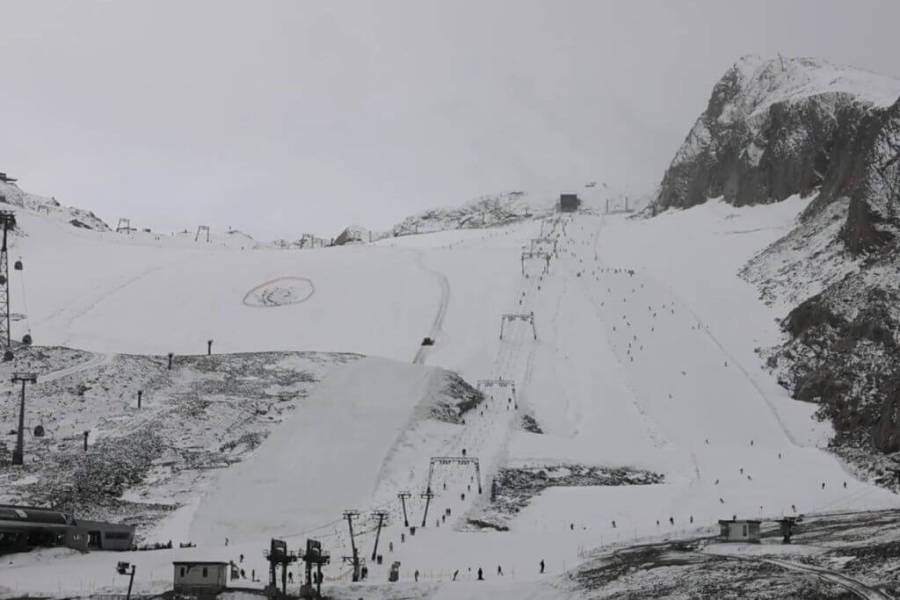 The Kitzsteinhorn glacier in Kaprun opens for skiing today – Photo: kitzsteinhorn.at, 10 October 2026
Snow conditions on the Kitzsteinhorn glacier are less than perfect today, but still much better than they might have been a few days ago, thanks to a modest fall of snow here on Thursday. What’s more, a few more centimetres of snow are expected here today, and across much of the northern Alps above 2200-2500m or so.
So right now, in Austria, it is possible to ski in Hintertux (15km pistes), Sölden (6km), Stubai (5km), Kaprun (4km) and Pitztal (2km). In Italy you can ski in Passo Stelvio (3km) and Val Senales (1km), while in Switzerland you can ski in Saas-Fee (10km).
Of these ski areas, Hintertux may currently offer the greatest extent of terrain, but Saas-Fee probably has the best snow conditions, as the western Alps got more of Thursday’s fresh snow than in the east.
As we move into next week, the weather in the Alps will turn more settled and a bit warmer again, meaning that any lower-lying snow (most of this being in the western Alps) from last Thursday’s storm will quickly melt.
Updated: – Two more glacier ski areas open with fresh snow in the Alps!
The glaciers at Sölden and Stubai open today, taking the number of available skiing options in the Alps to seven.
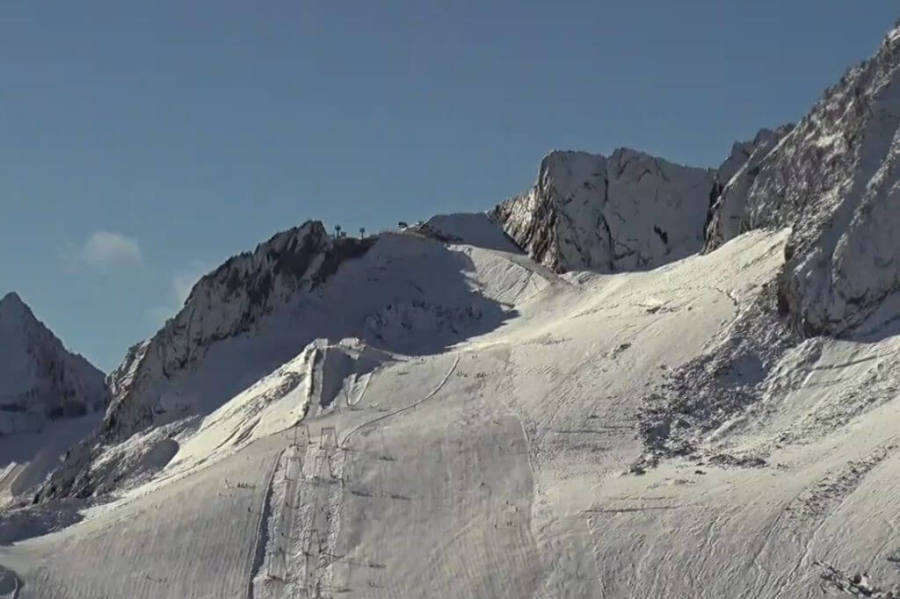 A few centimetres of fresh snow for opening day at the Stubai glacier in the Austrian Tirol – Photo: stubai-gletscher.com, 9 October 2026
The weather in the Alps has also changed with, as forecast, snow falling across many higher parts yesterday, albeit in varying quantities.
As expected, the western Alps saw the highest snowfall totals with around 30-40cm of windblown snow at 3000m in the (not yet open) Alpe d’Huez and Les 2 Alpes areas. More generally across the western Alps, we saw between 10cm and 30cm of snow at high altitude, enough to significantly transform the landscape in other glacier areas like Saas-Fee and the hopefully soon-to-be-open Zermatt.
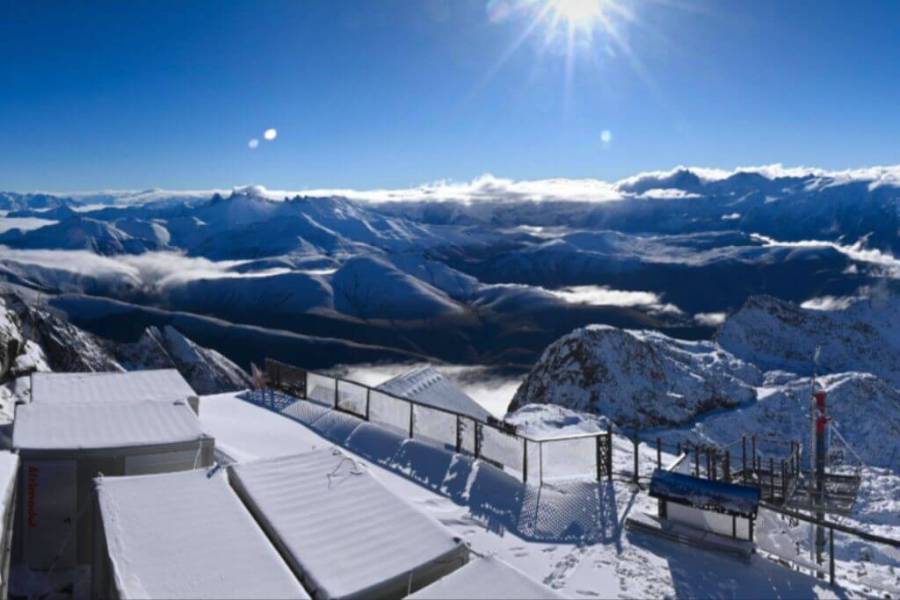 Significant fresh snow up top in Alpe d’Huez, though skiing is unlikely to commence here until later in November – Photo: alpedhuez.com, 9 October 2026
Late some snow reached as low as 1600-1900m in places, but only very temporarily and in very modest quantities.
On the whole, snowfall totals were far more modest further east with just a few cm on the Austrian glaciers. However, even here, it was enough to improve the quality of the piste skiing, not to mention good timing for the openings of Stubai and Sölden , and the Kitzsteinhorn glacier in Kaprun which is set to join the action .
So , in Austria it is possible to ski in Hintertux (15km pistes), Sölden (6km), Stubai (5km), Pitztal (2km), with the Kitsteinhorn in Kaprun opening . Meanwhile, in Italy you can ski in Passo Stelvio (3km) and Val Senales (1km), and in Switzerland, you can ski in Saas-Fee (10km).
Of these areas, Hintertux may be offering the greatest extent of terrain, but Saas-Fee probably has the best snow conditions.
As for the weather forecast for the Alps over the coming days, some further showers and a dusting of high-altitude snow is expected on .
The weather will then settle down again later in the weekend and into next week, with plenty of fine and relatively warm weather. This means that any low-lying fresh snow will quickly melt, but up on the glaciers snow conditions should remain reasonable for a time.
Updated: – A taste of winter as snow falls in some parts of the Alps!
As expected, the weather in the Alps has turned cooler and more unsettled, with snowfall for some higher areas today, especially in the west.
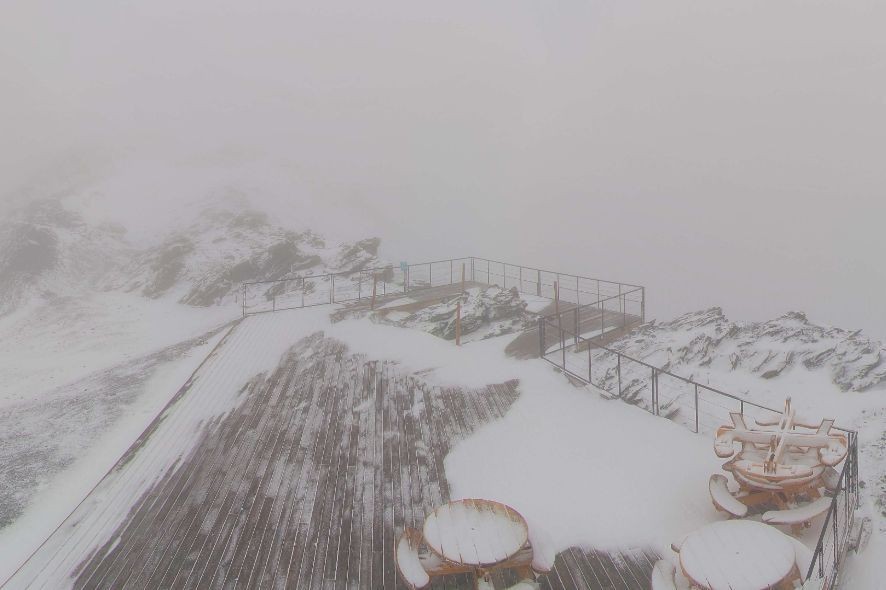 Fresh, albeit very windswept snow at 3000m above La Plagne this morning – Photo: la-plagne.com, 8 October 2026
the bulk of the precipitation is falling in the northern and western French Alps and the northern Swiss Alps. As the day progresses the bad weather will move further east to affect many other parts of the Alps, although will lose its intensity as it does.
The rain/snow line will eventually fall to around 1500-1700m in the northern western Alps , but will remain higher for longer the further south-east you are.
The greatest snowfall is likely to be in the western French Alps with around 40cm possible on the (not yet open) glacier at Les 2 Alpes by . More generally, we are likely to see 5-20cm of fresh snow above 2800m by with a very temporary dusting to as low as 1800m in some north-western parts of the Alps.
There will be further showers and an additional dusting of snow at high altitude in places on and before it turns drier again later in the weekend and into the first part of next week.
Right now, 5 ski areas are open for skiing in the Alps (weather permitting), these being Saas-Fee in Switzerland, Passo Stelvio and Val Senales in Italy, and Hintertux and Pitztal in Austria, with more Austrian ski areas opening soon.
Sölden and Stubai in the Tirol will open their glaciers for skiing tomorrow (Friday 9 October), followed by the Kitzsteinhorn in Kaprun on Saturday 10 October.
Updated: – Significant snowfall forecast in some higher parts of the Alps!
The weather in the Alps is changing, with significant snow expected at high altitude in the Alps over the next 24 hours, especially in the west.
 Significant snowfall is expected across some higher parts of the western Alps tomorrow (8 October) – Image: Met Office chart, 7 October 2026, annotated by Weather to Ski - Contains public sector information licensed under the Open Government Licence v3.0
Today there are already plenty of showers or longer spells of rain across the western Alps (i.e. the French Alps, the far western Swiss Alps and the western Italian Alps).
However, with mild air still in place, the rain/snow limit remains high for the time being – typically around 3000m. Precipitation will become more widespread on Thursday but will remain heaviest in the western and north-western Alps where 20-40cm of snow is possible above 3000m, including on the (not yet open) glaciers of Les 2 Alpes and Tignes.
More generally at high altitude across the Alps there will be falls of 5-20cm of new snow, although some far southern and south-eastern areas (e.g. the Dolomites) may see next to nothing.
With colder air digging in on Thursday the rain/snow limit will also descend, reaching 1500-2000m in most places by the end of the day – first in the north-west, and lastly further south-east.
While there is nothing remotely remarkable about this upcoming snowfall, it will significantly improve snow conditions on the glaciers in the Alps, both on those that are open and not yet open for skiing.
This is always good news after a hot summer, especially after this year’s torrid one, which saw unusually warm and dry weather in the Alps extending right through September.
Updated: – Snow is forecast for the Alps on Thursday!
The weather models have been hinting at it for a little while, but they are now in unanimous agreement: snow is forecast across the Alps on Thursday, and potentially to quite low altitudes too.
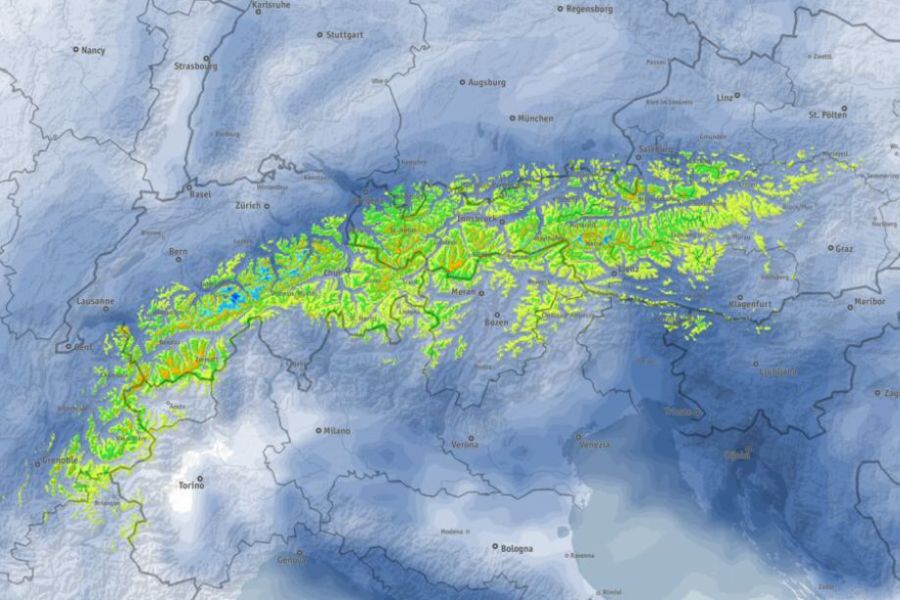 Modest, but quite widespread snowfall expected to relatively low levels in the Alps on Thursday (8 October) – Image: bergfex.com, 5 October 2026
Before anyone gets too excited, however, the usual caveats apply. Snow in the Alps in early October is neither unusual, nor does it tell us anything about how early-season snow conditions might pan out. We’re also NOT talking about a mega-dump.
What we should see, though, is enough fresh snow to improve skiing conditions on the glaciers, all of which are in dire condition following what is widely considered to have been the hottest summer on record in the Alps, with exceptionally warm and dry weather continuing throughout September.
We’ve already seen flurries across some eastern parts of the Alps today, giving a dusting to some of the Austrian glaciers, including Hintertux. But these are localised, high-altitude and very modest snowfalls.
The more significant change will arrive later on Wednesday as more active weather fronts move in, introducing colder polar air from the north-west.
Initially, the rain/snow limit will be close to 3000m, but the snowline will fall rapidly on Thursday, dropping below 2000m, with a dusting possible as low as 1500m in places.
The heaviest precipitation from this autumn storm is expected in the northern Alps, where around 5–15cm of fresh snow is likely above 2500m, with 20cm or more possible in some favoured spots.
Temperatures will turn a little milder again on Friday, but conditions will remain unsettled, with further dustings of snow likely at glacier level.
So, while this is certainly not the start of winter, Thursday’s snowfall should provide a welcome refresh for the Alps’ struggling glaciers — and make things look a bit more wintry, at least for a time…
Updated: – Saas-Fee reopens for skiing today!
Saas-Fee’s glacier reopens for skiing today, in Switzerland, seven weeks after operations were suspended on 10 August due to extreme heat. It becomes the fifth ski area in the Alps to open this autumn, although only its two highest surface lifts are currently running.
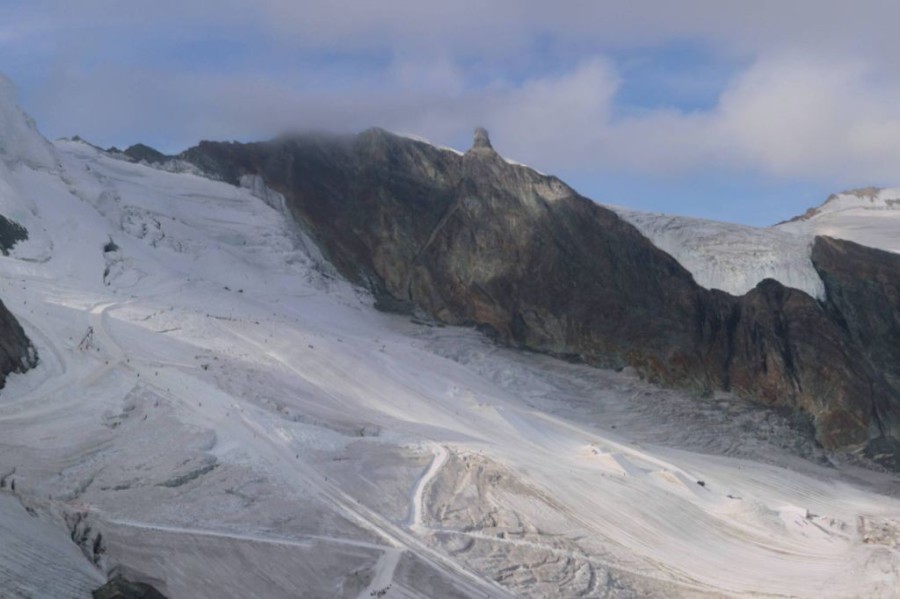 Saas-Fee reopens its glacier for skiing today, having suspended operations on 10 August – Photo: saas-fee.ch, 3 October 2026
The other ski areas currently open in the Alps include Austria’s Hintertux, the most extensive option right now with 12km of pistes on offer. Also in Austria, skiing is available on the glacier at Pitztal. In Italy, you can ski on the glaciers at Val Senales and Passo Stelvio.
After an exceptionally hot, record-breaking summer in the Alps, September continued to be very warm and dry, meaning that snow conditions at the select few glaciers currently open remain poor and are being heavily managed.
The weather forecast for the Alps does offer some hope for the alpine glaciers, with the first significant high-altitude snowfalls of the autumn possible later next week, though it is still too early to be sure. Watch this space…
Updated: – Hintertux glacier opens for skiing today!
The glacier at Hintertux opens today, now the fourth option for skiing in the Alps this autumn, after Italy’s Passo Stelvio and Val Senales, and Pitztal in Austria.
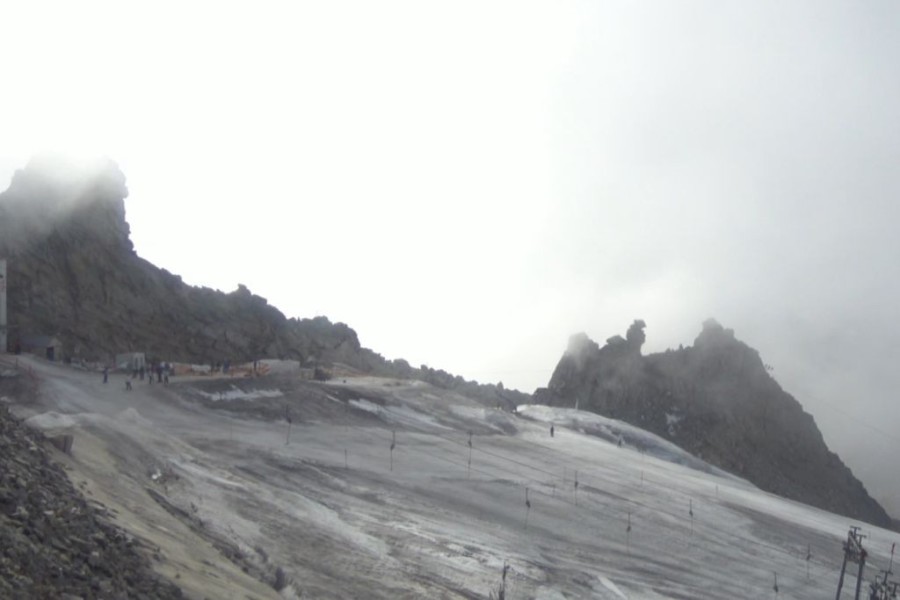 A less-than-ideal opening day of the ski season at the Hintertux glacier – Photo: hintertuxgletscher.at, 2 October 2026
Hintertux reports that 12km of pistes are open. However, with only a 5cm icy base to play with, not to mention the thick fog and drizzle shrouding the area early this morning, it won’t go down as the best opening day of a ski season in the Alps!
The weather in the Alps should improve later today, and especially tomorrow, when the glacier at Saas-Fee in Switzerland will also reopen for skiing having suspended operations on 10 August. However, the snow quality remains very poor across all skiable glaciers in the Alps, with not much sign of any serious relief coming any time soon.
There may be a little high-altitude snow in the Alps later next week but that’s still a long way off, so remains very uncertain at this stage.
Updated: 10.20am Saturday 26 September 2026 – Pitztal glacier opens for skiing today!
The Pitztal glacier in the Austrian Tirol opens for skiing today, joining Passo Stelvio and Val Senales in Italy to become the third skiing option in the Alps this season.
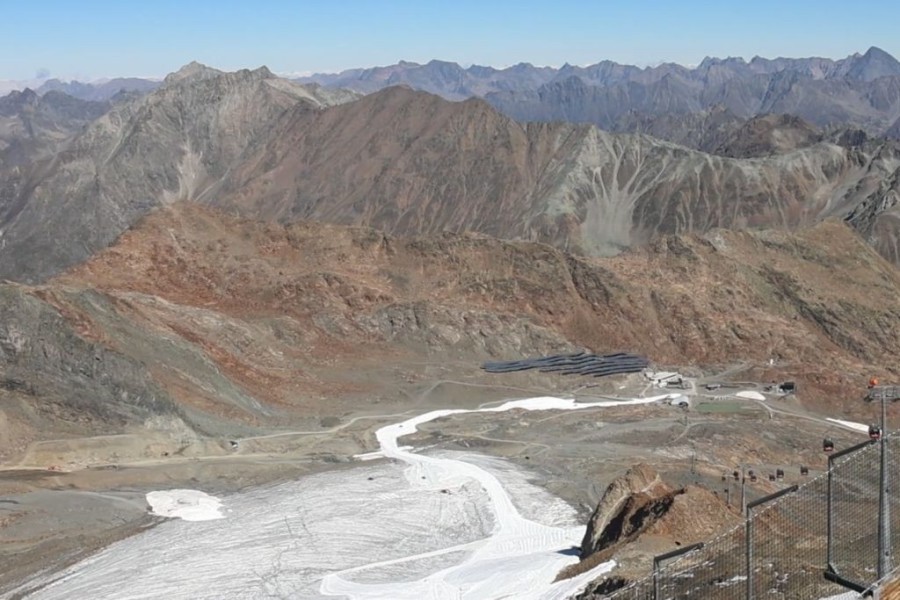 Skiing on the Pitztaler Glacier starts today. This is how preparations looked on Tuesday 22 September, before a dusting of snow temporarily blanked the higher peaks – Photo:pitztal.com, 22 September 2026
The extent of skiing on all these glaciers remains very limited with just two runs open in Pitztal on a heavily managed base. There was a dusting of snow on the Austrian glaciers mid-week, though not enough to radically transform the otherwise barren landscape for any length of time. Overall, the weather in the Alps this September has again been exceptionally dry and warm.
Looking a bit further ahead, the forecast for the Alps remains unfavourable for the glaciers, with next week set to get off to a very warm start across the board. It will turn a fraction cooler mid-week with some showers and even a dusting of snow possible at high altitude, however, temperatures will remain above average for the foreseeable future.
Next weekend will see Hintertux - which until recently opened 365 days a year –open its glacier for skiing for the first time since July. Sölden and Kaunertal, however, have postponed their openings and (at the time of writing) have yet to confirm until what exact dates.
Read our latest blog to find out where you can normally ski in the Alps in September…
Updated: 10.30am Saturday 19 September 2026 – Val Senales opens for skiing today!
The glacier at Val Senales, also known as Schnalstal, opens for skiing today. It joins Passo Stelvio as one of just two skiing options in the Alps right now.
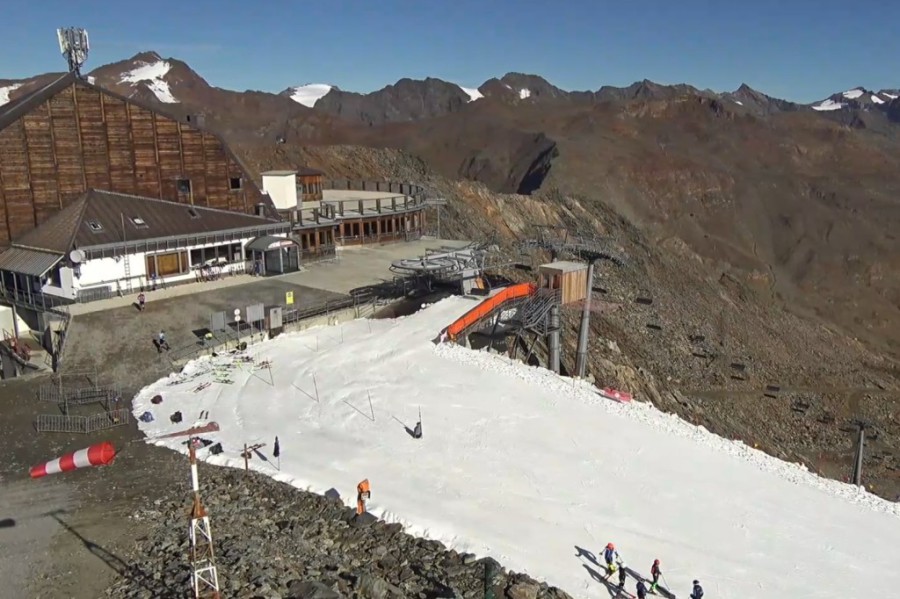 Val Senales/Schalstal opens for skiing today, but on a very limited basis with less than 1km of open piste! – 19 September 2026 – Photo: schnalstal.com
Before anyone gets too excited, the extent of available skiing at Val Senales is, for now, very limited (less than 1km of piste) and is entirely dependent on artificial snow. Passo Stelvio is only slightly better with around 3km of pistes open.
The next wave of glacier skiing openings are expected to be in Austria, where Pitztal, Kaunertal, Kaprun and Sölden are all scheduled to open next weekend (25-26 September 2026). However, with snow conditions remaining poor, some of these areas may push these opening dates back.
The weather in the Alps is not very promising for snow sports enthusiasts right now. It is mostly dry and warm again, and will turn quite hot even in the western Alps where freezing levels are set to surpass 4000m for several days in a row.
Towards the end of next week, it may turn cooler from the east with a sprinkling of snow possible on the Austrian glaciers, albeit nothing significant at this stage. Indeed, it will probably turn very warm again towards the end of the month.
Updated: 11.25am Friday 11 September 2026 – Fresh snow in the Alps!
Following an exceptionally hot summer, the weather in the Alps has turned a little cooler and more unsettled in recent days, culminating in the first significant snow at high altitude since late spring.
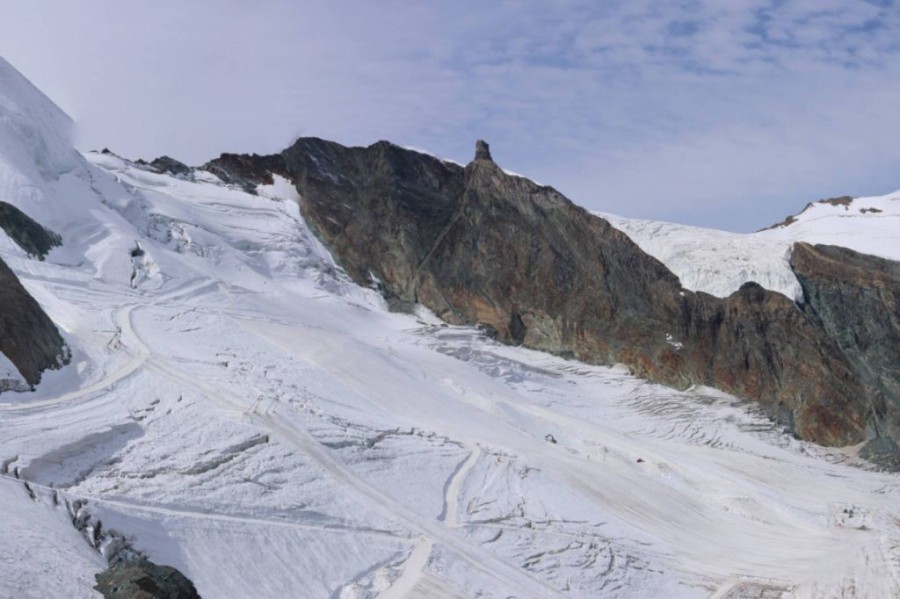 Saas-Fee’s summer ski area after this week’s dusting of snow – Photo: saas-fee.ch, 11 September 2026
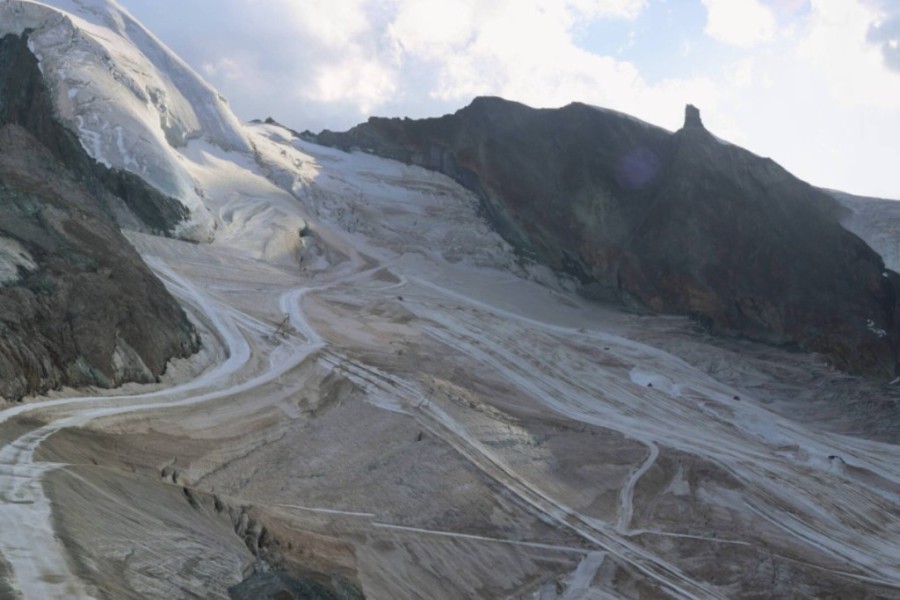 This was how Saas-Fee looked before this week’s snow – Photo: saas-fee.ch, 8 September 2026
As usual, we are at pains to point out that this snow means nothing in terms of the coming winter ski season. However, with a temporary dusting as low as 2600m and 20cm+ in places above 3400m, it has at least spruced up the appearance of the glaciers, which have suffered unprecedented damage this summer, in the context of the “skiing era”.
Whether or not this fresh snow will be enough to allow either Zermatt or Saas-Fee to contemplate reopening their glaciers for skiing any time soon remains to be seen. Due to the combination of heatwaves and high-altitude rain, Zermatt, which is normally open for skiing all year-round, suspended operations on , while Saas-Fee (which opened in mid-July) gave up just 10 days later.
At the time of writing, the only ski area in the Alps currently open is Italy’s Passo Stelvio, although Val Senales (Schnalstal) hopes to join the action on .
In Austria, the glaciers at Sölden, Hintertux, Pitztal and Kaunertal are all expected to open for skiing around or .
Updated: 12pm Friday 4 September 2026 – Passo Stelvio reopens its glacier for skiing today!
The glacier at Passo Stelvio has reopened for skiing today due to “the drop in temperatures” over the last couple of weeks.
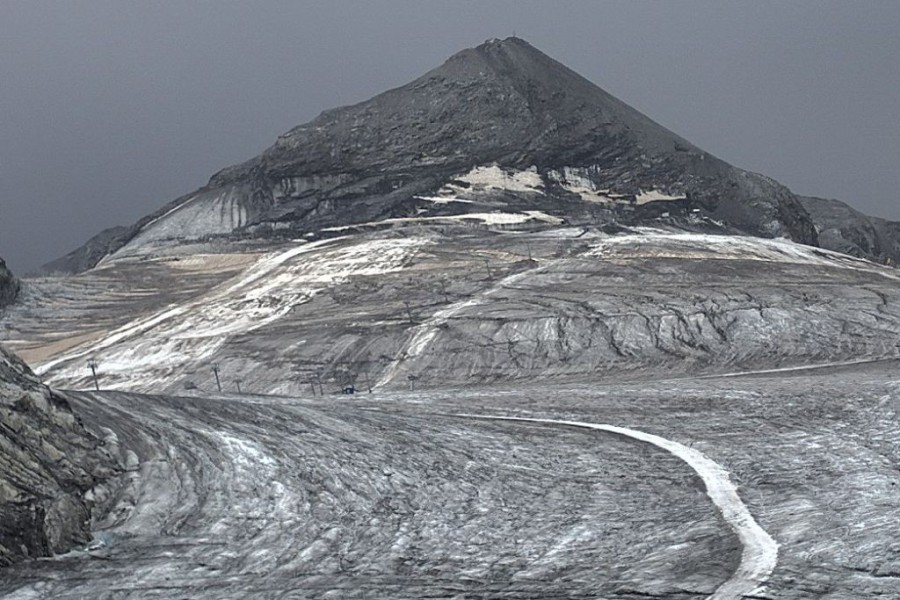 Passo Stelvio has reopened for skiing today, but the webcams are down! This is how it looked back on 15 August 2026 at the start of its unscheduled summer closure – Photo: pirovano.it, 15 August 2026
Ironically, it has just turned hot again in the Alps. Exceptionally so in the western Alps, where temperatures will hit the mid 30°Cs in some lower valleys (e.g. Grenoble) over the next few days.
Towards the second half of next week, the weather in the Alps will turn a bit cooler and more unsettled, but for how long is uncertain, as the heat won’t ever be far way.
Updated: 4.45pm Friday 21 August 2026 – A change of weather in the Alps at last!
After weeks of relentless heat, the weather in the Alps finally broke , with just about all regions seeing significant rainfall.
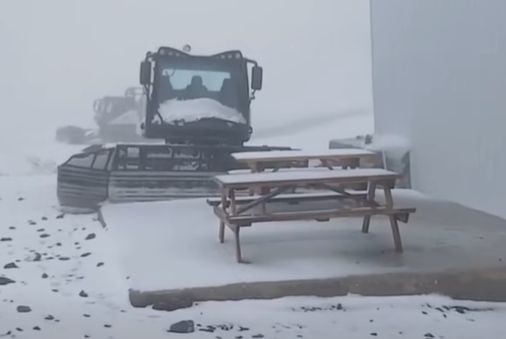 A temporary sprinkling of snow at 3200m in Les 2 Alpes earlier this morning – 21 August 2026 – Photo: Meteo Oisans
The heaviest rain has fallen in the southern Alps, where there were also some spectacular thunderstorms. The rain/snow limit remained high , generally around 3500–3700m, but has lowered a little , meaning that there is some fresh snow on the higher glaciers, mostly above 3200m or so.
However, this snow probably won’t change the situation in the Alps much, following a summer of record-breaking temperatures which has led to there being no open summer skiing options in the Alps for some time now.
Over the next couple of weeks, the weather in the Alps looks set to be fairly changeable. It will warm up again next week, with temperatures in the lower valleys into the high 20°Cs mid-week.
Later next week the weather will turn more unsettled, and a little cooler again, but we are a long way off any sign of the glaciers re-opening for skiing.
Updated: 5.20pm Saturday 15 August 2026 – Passo Stelvio suspends its ski operations today, leaving the Alps with no summer skiing options - perhaps for the first time ever!
With the continued warm weather across the Alps, it was sadly inevitable that the last summer skiing option left standing in the Alps, Passo Stelvio, has also now suspended operations as of today (15 August).
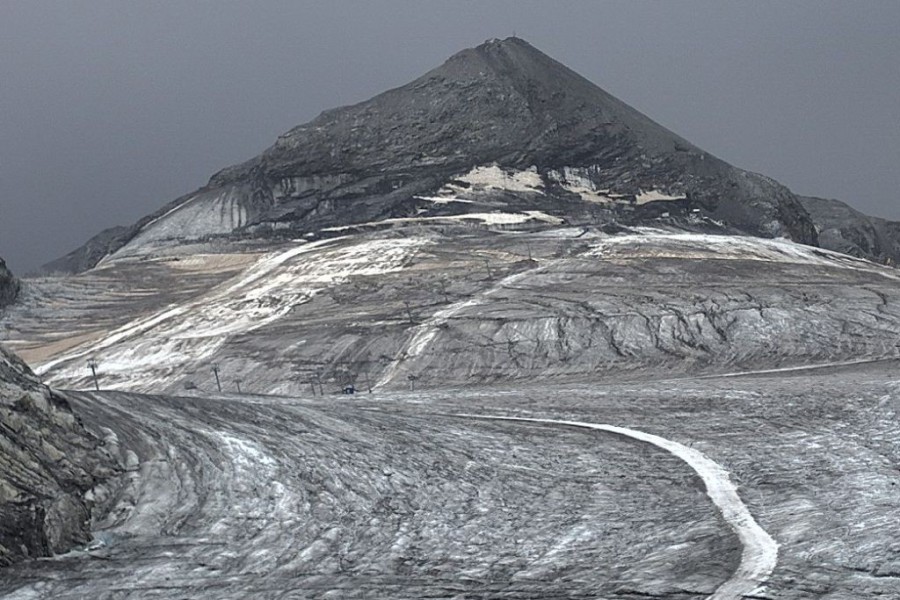 The last remaining summer ski area in the Alps in 2026, Passo Stelvio, has suspended operations today (15 August 2026) – Photo: pirovano.it, 15 August 2026
Italy’s Passo Stelvio, which doesn’t open for skiing in the winter, is one of the Alps’ last true summer ski areas, usually open from late May until early November.
Its early closure follows the unscheduled early closures of Saas-Fee and Zermatt-Cervinia, meaning that for the first time since summer skiing began, there is currently no summer skiing on offer anywhere in the Alps!
The relentless heatwaves which have affected much of western Europe since the end of May, and the large number of violent thunderstorms with very high rain/snow limits (sometimes as high as 4000m) have made it impossible to keep any summer skiing area in the Alps viable this year.
The very hot weather currently afflicting the Alps should ease a little as we move through the second half of August but it’s almost certainly too late to resurrect any summer skiing, and it will probably be deep into September before any of the glacier ski areas consider opening again.
Updated: 9.20am Friday 7 August 2026 – Saas-Fee to suspend summer skiing operations…
Saas-Fee has announced that it will suspend summer skiing on 10 August, just three weeks after opening on 18 July!
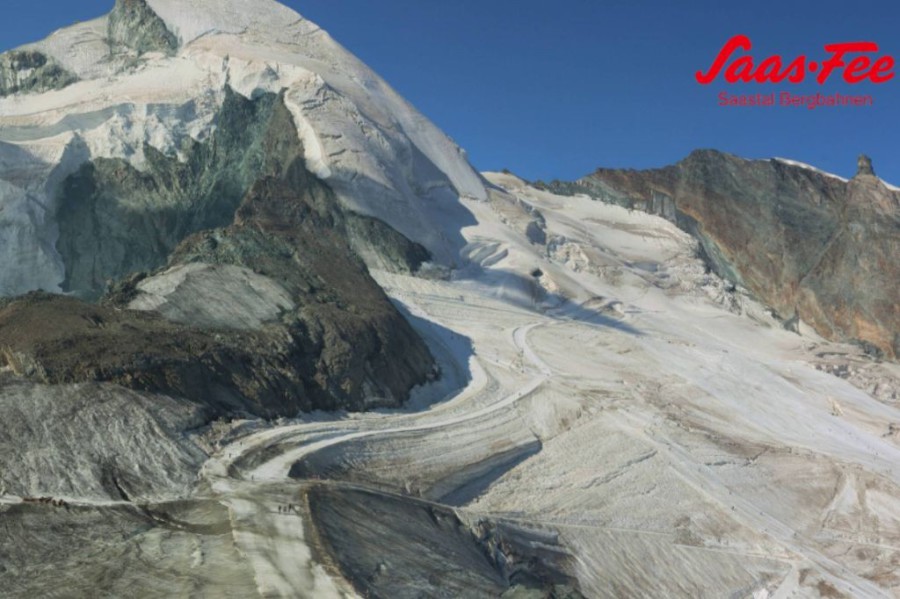 Very poor snow conditions on the glacier above Saas-Fee, where summer skiing will be suspended on 10 August 2026 – Photo: saas-fee.ch, 7 August 2026
This comes off the back of an exceptionally hot summer in the Alps, likely the hottest ever in the western Alps, when freezing levels have often been between 4000m and 5000m, with temperatures in the lower valleys climbing into the mid or even high 30°Cs.
To further complicate matters, there have also been an unusual number of severe thunderstorms, including near the main Alpine ridge around Zermatt/Saas-Fee, traditionally one of the drier parts of the Alps. With rain falling as high as 4000m, these storms have accelerated the thaw and destabilisation of the glaciers.
With Zermatt and Hintertux also having closed in recent weeks, this leaves the one remaining summer ski option in the Alps being Italy’s Passo Stelvio, albeit also now in very poor condition. Nor will there be any let up this week, with temperatures remaining elevated across the Alps and renewed heatwave conditions likely again next week.
Updated: 12pm Saturday 25 June 2026 – New heatwave incoming!
It has been an exceptionally hot summer so far in the Alps, and one of the hottest ever in the western Alps – including the French Alps, western Switzerland (e.g. the Valais) and north-western Italy (e.g. Aosta valley).
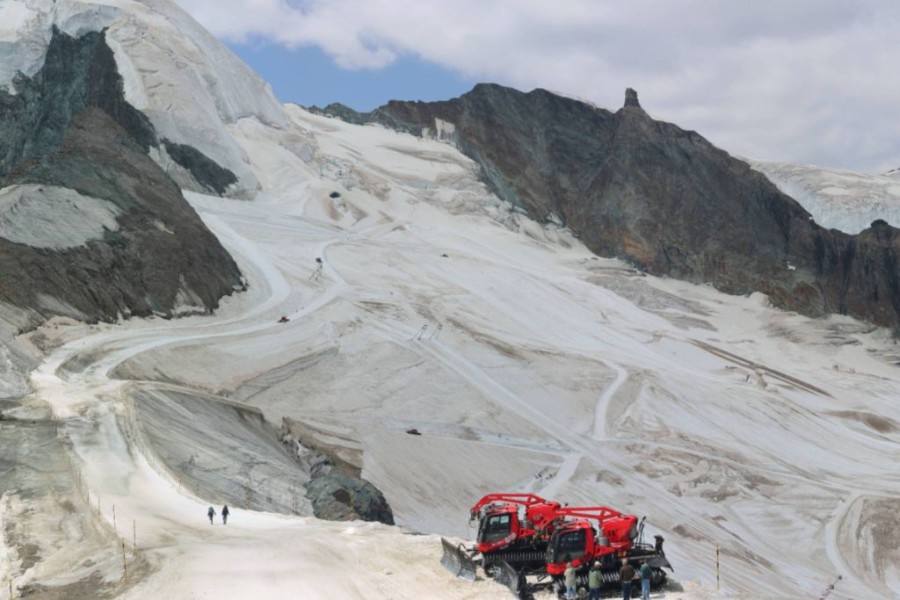 Snow conditions on the Alpine glaciers are less than ideal. This is Saas-Fee, one of just three remaining options for skiing in the Alps right now – 25 July 2026 – Photo: saas-fee.ch
The good news is that the weather in the Alps will turn noticeably cooler over the and into the . The bad news, however, is that this cooler incursion will be very transitory, with the heat returning on .
Indeed, by most of the Alps will again be under “heatwave” conditions, meaning temperatures into the mid-, and sometimes even high 30°Cs in the lowlands, with freezing levels approaching 5000m!
Needless to say, snow conditions on the few glaciers currently open for summer skiing are less than ideal, with Hintertux having closed , a week earlier than its scheduled finish.
and might see a very temporary improvement in snow conditions, with the highest glaciers even seeing a little fresh snow from the showers and storms forecast this . Fundamentally though, the glaciers are in very poor condition for late July, with no guarantee that those scheduled to remain open for the rest of the summer will be able to do so.
For now, there are just three summer ski options in the Alps – four if you separately count Cervinia (Italy) and Zermatt (Switzerland), which share a glacier. The only other possibilities are Saas-Fee (Switzerland) and Passo Stelvio (Italy). All the alpine options are extremely limited.
Updated: 10am Friday 17 July 2026 – The intense heatwave is easing in the Alps...
The intense heatwave, that has affected the Alps for several weeks now, is finally easing as slightly cooler air moves down from the north.
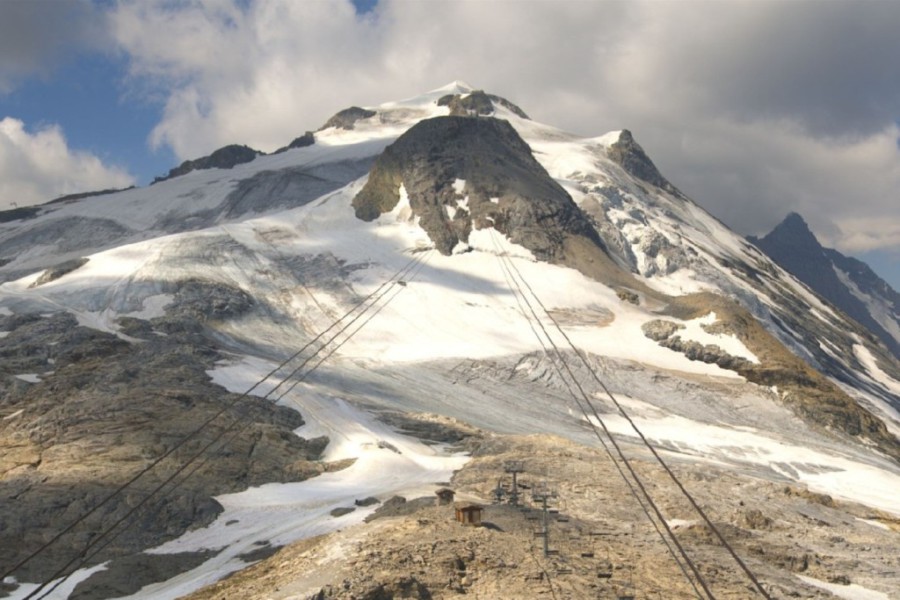 The Grande Motte glacier in Tignes today, showing how much snow has been lost over the last month due to the heatwave– Photo: tignes.net, 17 July 2026
That said, the weather in the Alps will remain very warm over the next few days, it will just lose the extreme heat that has not only affected the Alps but also much of western Europe.
Not surprisingly, snow conditions on the Alpine glaciers have deteriorated significantly since we last reported, as shown by our images of the Grande Motte glacier above Tignes taken less than one month apart. It is not surprising that Tignes closed its summer skiing operation a few days early, on Wednesday, as snow conditions here became increasingly marginal.
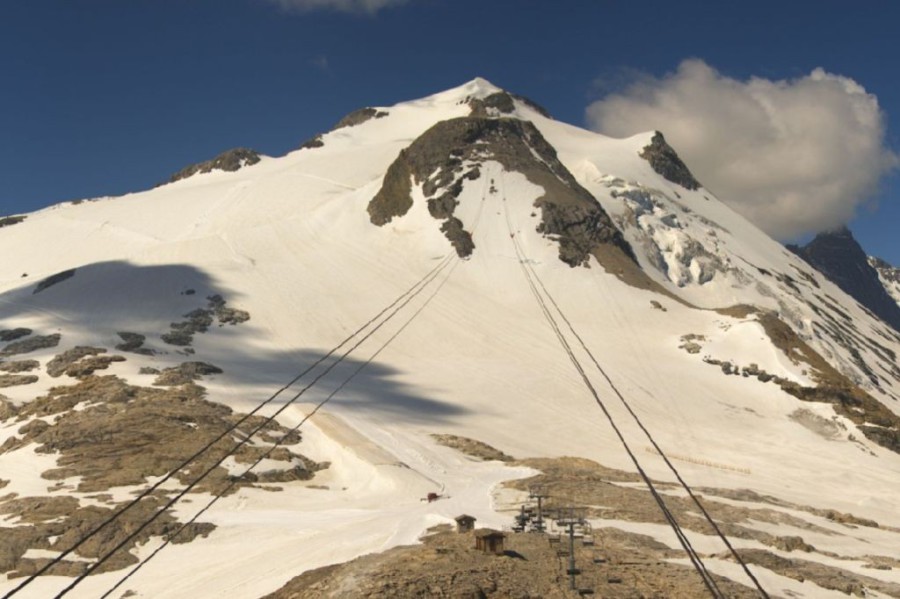 The Grande Motte glacier in Tignes on 18 June 2026, before the heatwave took its toll on the snow – Photo: tignes.net, 18 June 2026
Elsewhere in the Alps, you can still ski on the glacier above Zermatt/Cervinia, although the lift operations are closed today due to adverse weather last night when heavy rain affected the area.
The other options for summer skiing are Passo Stelvio, Hintertux and, from tomorrow, Saas-Fee. However, none of these areas are in good shape and unscheduled early closures remain a possibility, especially if the intense heat returns.
Updated: 10am Thursday 18 June 2026 – Intense heat returns to the Alps!
Following an exceptionally hot end of May, the weather in the Alps became more “normal” in early June. However, over the last few days, temperatures have been soaring again as another exceptional heatwave engulfs much of western Europe!
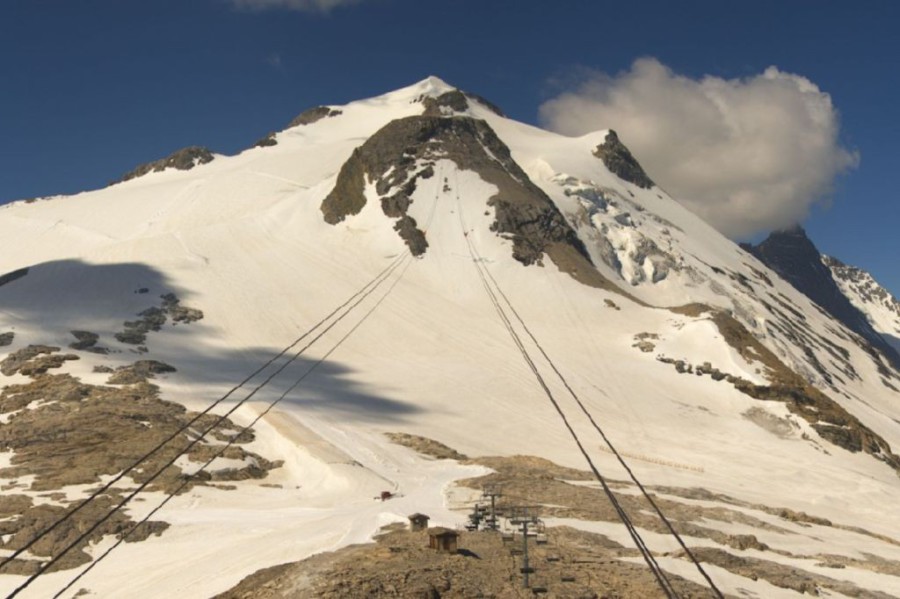 The Grande Motte glacier above Tignes (opening 20 June 2026) remains in reasonable shape for now but, with heatwave conditions forecast in the western Alps, snow conditions are likely to become increasingly challenging over the coming days – Photo: tignes
Although it will be hot across all parts of the Alps, as in late May it will be the western Alps that will see the most extreme temperatures, with 35°C+ commonplace in the lower valleys over the weekend and especially early next week. Some areas (e.g. Grenoble) could see temperatures even approaching 40°C with freezing levels as high as 4500-4800m.
There remains some uncertainty as to exactly how long the extreme heat in the Alps will last, however, most models agree that heatwave conditions are likely for at least a week and, quite likely, much longer.
This second bout of exceptionally hot weather in the Alps is obviously not good news for the glacier where, after a generally good spring and early summer skiing season, snow conditions have started to and will continue to deteriorate at increasing pace over the coming days.
Right now, summer skiing is possible in 5 to 6 resorts in the Alps, depending on whether you count Zermatt and Cervinia (with their shared glacier) as one or two. The other options are Les 2 Alpes, Hintertux, Val d’Isère and Passo Stelvio.
Tignes is set to join the action this weekend, with its Grande Motte glacier area (pictured) just about holding up for now. However, you can expect ice to be showing through here soon as is also likely on other glaciers elsewhere.
Thanks to climate change, summer heatwaves in the Alps have become much more frequent and severe in recent years. This has forced summer ski areas to reconsider how they operate, with many bringing their seasons forward to concentrate on spring and early summer, rather than attempting to remain open through the hottest months.
Check out our revised and updated blog for everything you need to know about skiing in the Alps in June.
Updated: 11am Monday 1 June 2026 – The heatwave in the Alps is over...
Following an exceptionally hot couple of weeks in the Alps, with record-breaking temperatures in places, the weather is now starting to cool down.
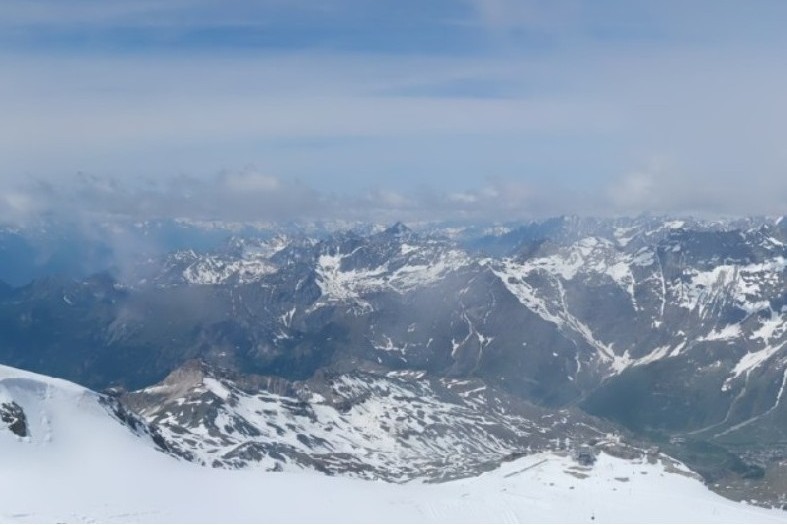 View from the top of the Klein Matterhorn this morning, in Zermatt’s summer ski area – 1 June 2026 – Photo: zermatt.ch
That said, it certainly won’t be cold, but temperatures will just be closer to what is expected at this time of year, with average freezing levels nearer 3000m rather than 4000m, as has been the case over the last couple of weeks, at least in the western Alps. There will also be some thunderstorms around, especially on Tuesday when they could be quite violent in places.
Later next weekend and into next week it will probably become hotter again, but how long this will last is too early to say at this stage.
Skiing options in the Alps in the first few days of June have dwindled to five, which are Les 2 Alpes, Hintertux, Cervinia, Zermatt and, as of today, Passo Stelvio in Italy.
Updated: 8am Thursday 28 May 2026 – Alpine heatwave to ease next week...
The weather in the Alps will remain exceptionally hot until the weekend, after which cooler air will slowly move in from the west.
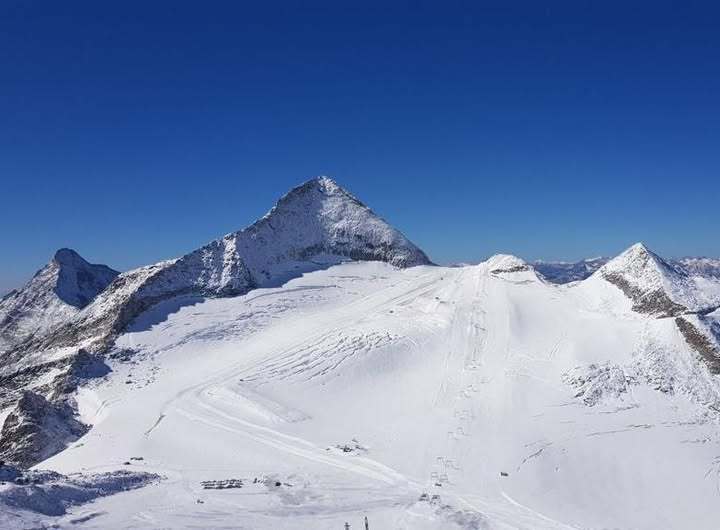 Good summer skiing on the Hintertux glacier this week – 28 May 2026 – Photo: Facebook.com/hintertuxergletscher
This historic spring heatwave, in place for nearly a week now, has most impacted the western Alps where freezing levels have been around the 4000m mark, and temperatures in the lower valleys often exceeding 30˚C. This would be considered hot even for the middle of summer but, for May, it is exceptional - unprecedented even in places, especially in the French Alps.
After a cool and, at altitude, quite snowy start to May, it is hardly surprising that snow conditions in the few ski areas still open have rapidly reverted to “full summer mode”. This doesn’t mean that there isn’t still some good skiing available, but the window of opportunity is narrow (early to mid-morning). By the middle of the day, the slopes become unpleasantly slushy, even at glacial altitudes.
Right now, you can ski in 5 resorts across the Alps:
Read our blog for more on where to ski in the Alps in May...
Updated: 9am Monday 25 May 2026 – Unprecedented spring heatwave in the Alps...
The Alps are currently experiencing an extraordinary spring heatwave, with little sign of any significant cooldown anytime soon.
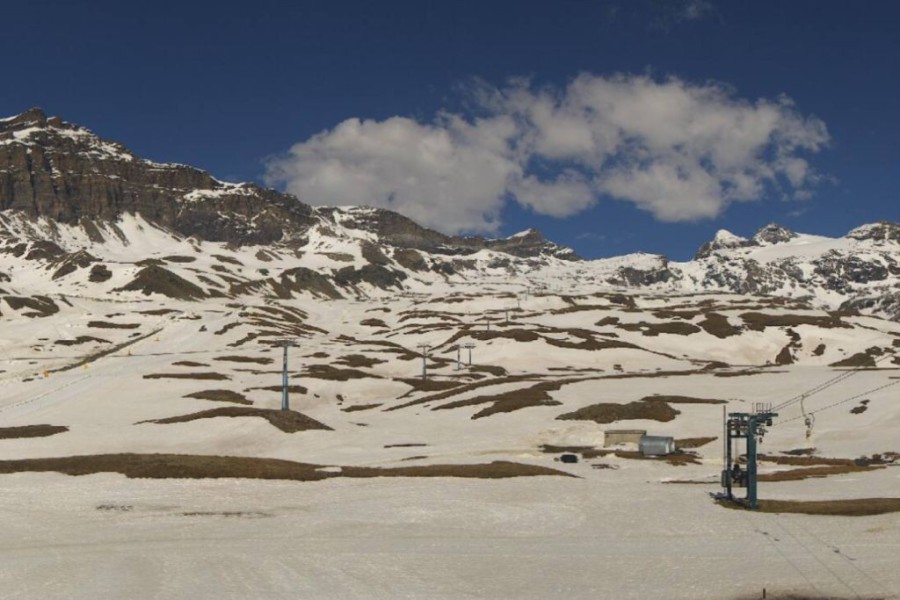 Rapid loss of snow above Cervinia but some non-glacial skiing is still possible for now – 25 May 2026 – Photo: cervinia.com
After a relatively cool start to May (and, at higher altitudes, quite a snowy one) conditions turned much warmer early last week, with freezing levels reaching or exceeding 4,000m across most of the Alps for several consecutive days. At lower altitudes, this has brought temperatures of 30°C or more.
While temperatures like these are not unprecedented in themselves, the persistence of the heat, combined with the fact that it is still spring, makes this Alpine heatwave particularly noteworthy.
Right now, you can still ski in 5 areas in the Alps, these being Les 2 Alpes in France, Cervinia in Italy, Zermatt in Switzerland, and Hintertux and Mölltal in Austria. Some non-glacial terrain still available in all of these ski areas except Mölltal.
Although early spring snow conditions in the Alps were excellent, the current heatwave has created very marked freeze-thaw conditions (mostly thaw), with the snow quickly softening in the strong sun, and becoming very slushy by late morning, even above 3000m.
For now, snow coverage on the glacier ski areas is still good, however, resorts planning to be open in the middle of summer (e.g. Zermatt, Saas-Fee, Passo Stelvio) will no doubt be monitoring the situation with some concern.
Updated: 8am Wednesday 20 May 2026 – Great snow conditions on the glaciers, but temperatures in the Alps are about to soar...
Following a cooler than average first half of May with significant fresh snow at altitude, snow conditions up on the alpine glaciers are currently excellent.
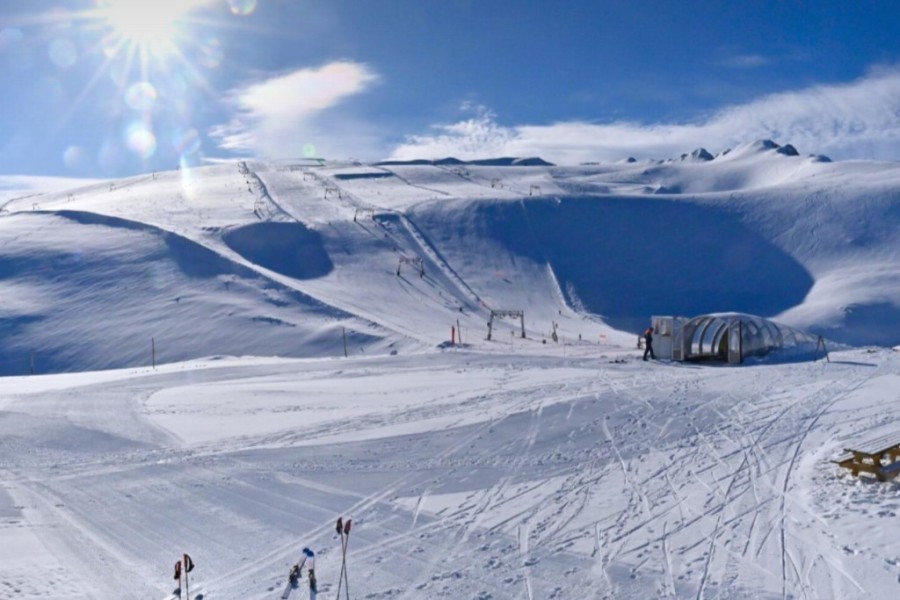 Excellent snow conditions up on the glacier in Les 2 Alpes but it will soon turn much warmer – Photo: Les2Alpes.com
However, the weather in the Alps is on the change, with high pressure bringing increasingly hot and sunny weather over the next few days. Indeed, temperatures will hit or surpass 30˚C in many of the lower valleys from onwards, with freezing levels above 4000m.
This will change snow conditions on the glaciers from relatively wintry (as seen in the last week or two) to more typical of mid-summer, with early hard snow quickly softening as the morning progresses, and plenty of slush by the middle of the day.
Right now, you can ski in 6 areas in the Alps, namely Les 2 Alpes, Zermatt, Cervinia, Kitsteinhorn, Hintertux and Mölltal.
Of these, Les 2 Alpes, Cervinia and Hintertux still have notable non-glacial terrain open, but for how long remains to be seen…
Updated: 1pm Sunday 17 May 2026 – Excellent snow conditions on the glaciers but warming up next week...
Following an unusually cold and snowy few days in the Alps, snow conditions on the glaciers are excellent right now, with significant fresh snow in all the open ski areas.
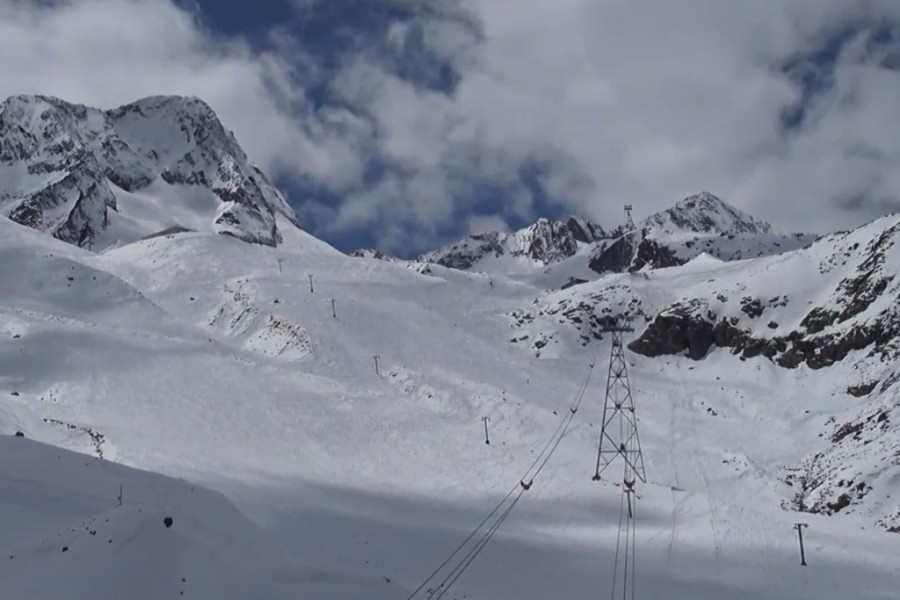 Excellent snow conditions today on the Stubai glacier although this is sadly its last day of the season – 17 May 2026 – Photo: stubai-gletscher.com
Although it is mostly dry again , a new wave of showers is set to arrive from the west . These will be heaviest later in the day and in Austria, where another 10-15cm of snow is possible at altitude. The rain/snow limit will be around 1500-2000m.
From onwards, an area of high pressure will start to establish itself across the Alps bringing increasingly fine and warm weather to all regions. Indeed, by the end of temperatures could reach into the high 20˚Cs at low altitude.
For now, though, snow conditions in the Alps are excellent in the few areas still open, all of which involve glacier ski areas. These are:
However, with summer weather returning later , and very warm temperatures likely to be set in for some time to come, there is no guarantee that snow conditions will still be as favourable a few weeks down the line…
Updated: 11am Wednesday 13 May 2026 – More snow forecast for the Alps!
After an exceptionally dry and warm April, the weather in the Alps has proved much more interesting in May, especially this week, with significant snow having already fallen in places and plenty more to come between tonight and Saturday night.
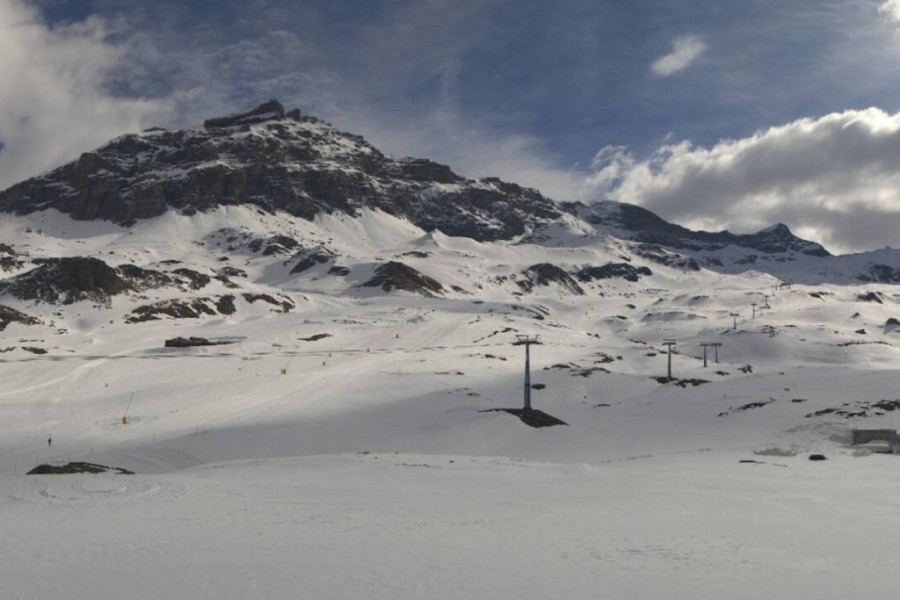 Great snow conditions still in Cervinia, even below the glacier here to 2550m in the Plan Maison area – 13 May 2026 – Photo: cervinia.it
In terms of the ski areas that remain open, this fresh snow has (so far) most benefited Les 2 Alpes, Cervinia and Zermatt. However, between and , it will be the eastern Alps that will see the most snow, with 50cm+ possible for the Austrian glaciers, while Les 2 Alpes and Zermatt / Cervinia will see more in the range of 5-20cm. The rain/snow limit will also be very low for May, typically between 1300m and 1700m, but as low as 1000m in places.
Needless to say, all this new snow is great news for the Alpine glaciers, many of which risked looking very threadbare early in the summer after what had, until now, been an exceptionally dry spring.
This late wintry spell will delay the thaw at altitude, but it does not by any means guarantee that snow conditions on the few glaciers planning to be open mid-summer (e.g. Saas-Fee, Zermatt) will be in great condition. Indeed, it looks likely that the weather in the Alps may turn hot again later with above average temperatures locked in for some time. Watch this space…
For now, weather-permitting, skiing in the Alps is possible in the following areas:
Updated: 11am Monday 11 May 2026 – Significant snow for some parts of the Alps this week...
The weather in the Alps will be very unsettled this week with generally below average temperatures and snow to 1000m or lower in places!
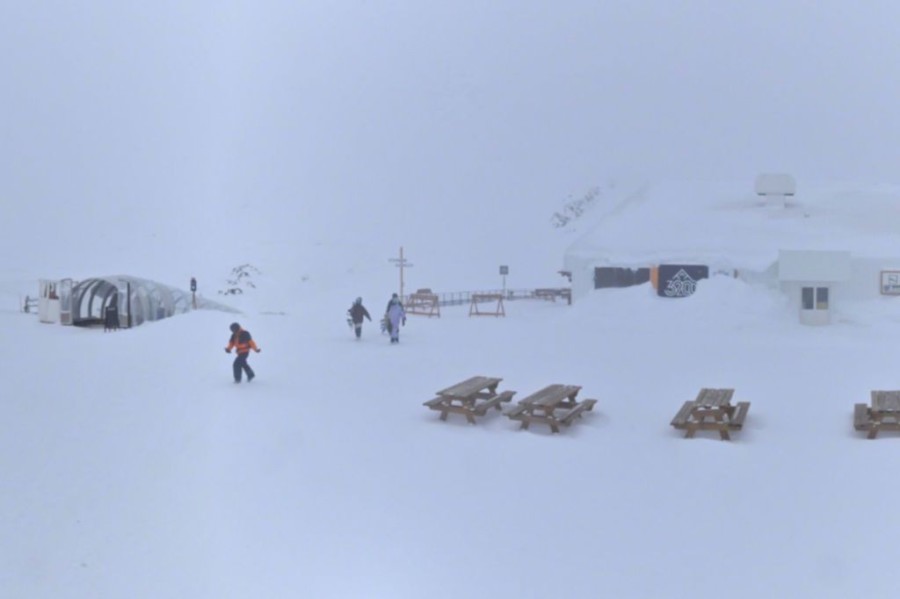 Les 2 Alpes has the best snow conditions in the Alps right snow, with more snow in the forecast this week – Photo: les2alpes.com, 11 May 2026
, bands of showers are crossing the Alps from west to east, heaviest later and , and in the north, with some rumbles of thunder in places. The rain/snow limit will start at around 2000-2300m before dropping to between 900m and 1500m in the northern Alps .
On , any rain or snow (1000m) will die out from the western Alps but continue for a time in the eastern Alps with snow falling to as low as 800m in some northern parts of the Austrian Alps. Although the southern Alps will also see showers over the next 24-hours it will be the northern Alps that see the heaviest precipitation, with 10-30cm of fresh snow above 2200m, and 40cm+ in places.
After a relative reprieve , new weather fronts will bring more rain or snow to the Alps late on and on , again heaviest in the north and with snow again falling to 1000m or lower in places.
This week’s snow forecast is great news for the alpine glaciers, nearly all of which have lower than average snow depths for the middle of May but will see much-needed top-ups over the next few days. Les 2 Alpes will also see these top-ups, but stands out as an exception, already having above-average snow depths on its glacier area.
Read our blog for more on where to ski in the Alps in May...
Updated: 9.30am Thursday 7 May 2026 – Epic snow conditions in some parts of the Alps today...
The main winter season is over, but there is still plenty of good skiing on offer in the Alps. This is especially true in France’s Les 2 Alpes, which arguably has the best snow conditions in Europe right now.
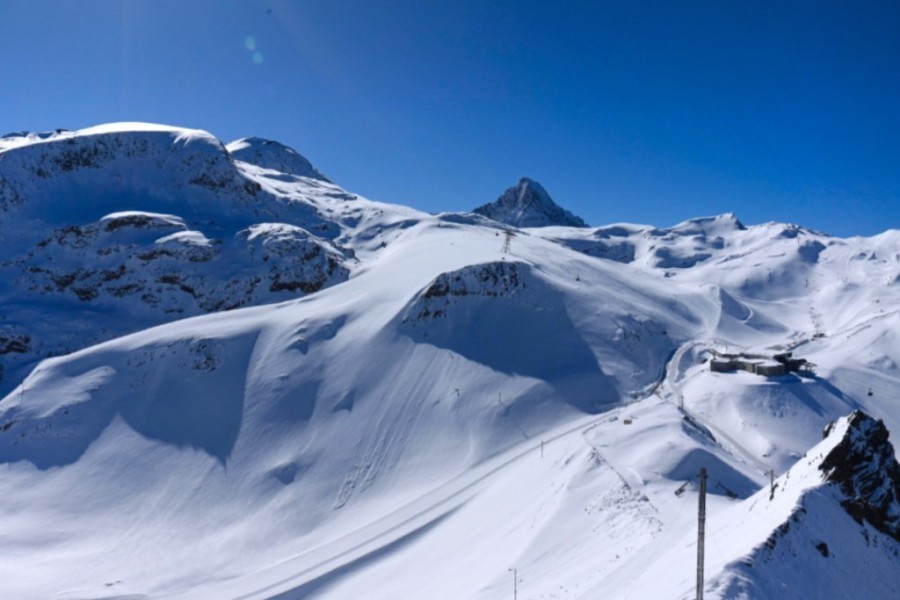 Blue skies and fresh snow at altitude in Les 2 Alpes – 7 May 2026 – Photo: les2alpes.com
So, why are snow conditions in Les 2 Alpes this good? The answer is due to a big storm earlier this week that mostly affected the western and south-western Alps (to various degrees). Les 2 Alpes sat right in the sweet spot (especially on Tuesday), collecting at least 50-70cm of snow at altitude! What’s more, the sun is back today and not only is the glacier in pristine condition, but you can also still ski on non-glacial terrain back down to 2600m.
The only other area in the Alps that is comparable right now is Zermatt/Cervinia, which also saw significant new snow this week, and where you can also still ski below glacier level – especially on the Italian side.
Elsewhere in the Alps, you can ski on the glaciers at Hintertux, Stubai, Kaunertal, Kitzsteinhorn, Mölltal and Val Senales. However, the snow conditions and variety of terrain available in these areas are currently not comparable to Les 2 Alpes and Zermatt/Cervinia.
Updated: 9am Wednesday 6 May 2026 – Heavy snow for parts of the Alps!
The main winter ski season may be over, but snow has returned to some parts of the Alps, especially the west.
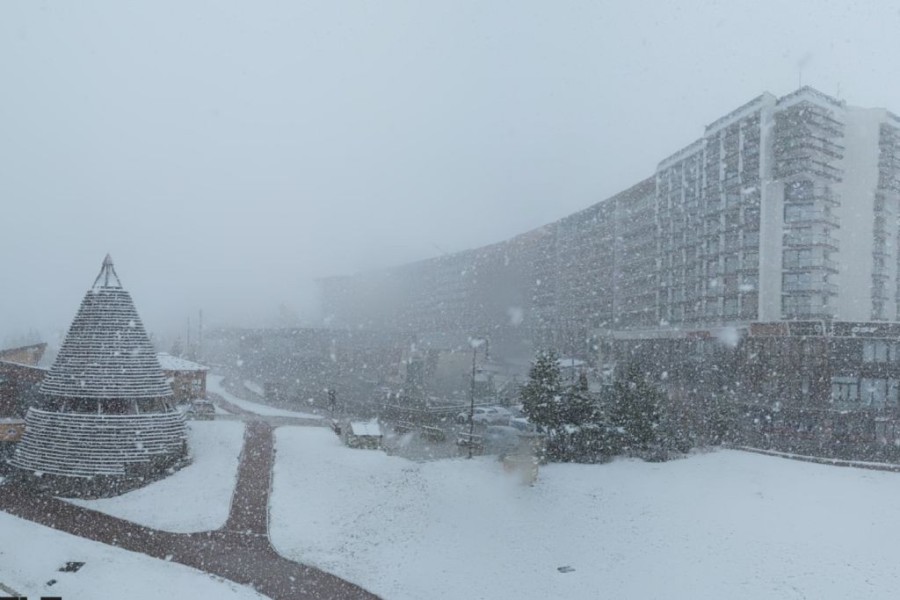 Heavy snow falling this morning in Tignes, although skiing here is not scheduled to reopen until late June – Photo: tignes.net, 6 May 2026
Indeed Les 2 Alpes, one of the few resorts still offering skiing right now, reported 50cm of fresh snow on its glacier yesterday, with further snow forecast today.
Many other parts of the Alps have also seen a least a bit of snow at altitude in the last day or two, heaviest in the west where the rain/snow level could dip below 2000m today.
For the rest of this week, the weather in the Alps will remain unsettled with further showers in places. However, with temperatures rising again, any snowfall will be increasingly confined to glacial altitudes.
Weather-permitting, around eight ski areas in the Alps are open this week, all of them on glaciers.
Updated: 1pm Sunday 3 May 2026 – Last “proper” day of the Alpine season...
It’s the final day of what many call the “ski season proper” in the Alps, with resorts like Val d’Isère, Tignes, Val Thorens and Ischgl all closing today. After today though, most skiing will be limited, or almost entirely limited, to glacier ski areas.
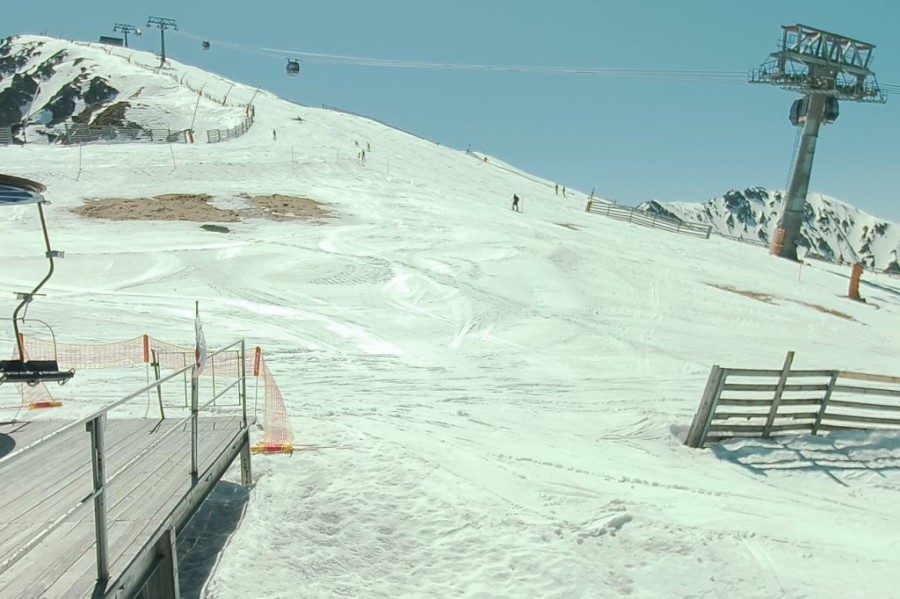 Most Alpine ski resorts may be closing today, but you can still ski in Slovakia! This is Jasná – 3 May 2026 – Photo: jasna.sk
Despite April having been exceptionally dry and warm, leading to a rapid melting of much of the lower-lying snow across the Alps, at higher altitudes, solid base depths and predominantly fine weather have provided excellent spring skiing in recent weeks. That said, overall snow depths are now below the norm for early May, which does not bode particularly well for the summer skiing season.
If you are planning to ski in the Alps this summer, May and June will generally offer the most options. Skiing in the Alps any later in summer is becoming increasingly uncertain these days.
Elsewhere in Europe, you can (believe it or not) still ski in Scotland’s Cairngorm, albeit on a very limited basis. Slovakia’s Jasná is also open, reportedly until 10 May. A handful of ski resorts also remain open in Scandinavia, as is usual at this time of year.
Spain’s Sierra Nevada also deserves a special mention. It may be closing today, but it has enjoyed an exceptionally snowy season and still has plenty of snow all the way down to resort level.
 Print