



Was Summer 2026 the hottest ever in the Alps?
by Fraser Wilkin, 12 September 2026
The summer of 2026 was the latest in a run of summers which have seen exceptionally high temperatures across western Europe, with records broken in many regions, including the Alps. Successive and often extreme heatwaves began in late May and continued into late August, accompanied by long periods of drought and widespread forest fires across southern and western Europe.
Destabilisation of the mountains at high altitude due to freezing levels often exceeding 4500m, and the associated thawing of permafrost, saw the closure of Mont Blanc to climbers due to the increased risk of rock falls and rock slides. August 2026 was also the first August since the era of summer skiing began to see an extended period with no summer skiing options in the Alps.
 Temperatures in Summer 2026 across western Europe were significantly above the long-term 1991-2020 average - Data source: ERA5. Credit: C3S/ECMWF
So, was Summer 2026 the hottest summer ever in the Alps?
Although there are no official datasets specifically covering temperatures in the Alps as a whole, the available evidence suggests that summer 2026 was almost certainly the hottest summer in the Alps since official meteorological records began, with only 2003 coming close overall.
In terms of alpine meteorological records, “since records began” does not mean going back thousands of years. European alpine weather records typically date back 125–250 years, depending on the country and weather station involved.
At a national level, MétéoSuisse has confirmed that summer 2026 (defined meteorologically as the months of June, July and August) was the hottest ever recorded in Switzerland.
As for Austria, GeoSphere (the Austrian national meteorological agency) has confirmed that summer 2026 was its hottest on record.
 Until recently, the Hintertux glacier used to open for skiing 365 days a year, but was already showing signs of deterioration by 26 June 2026 – Image: Carsten Steger
National temperature records are not, of course, the same as records for the Alps specifically. However, Switzerland and Austria provide a particularly useful indication of conditions in the Alps, given that they cover a greater proportion of their territory (around 60-65%) than in France or Italy.
In France, Météo France has also confirmed that summer 2026 was its hottest on record. In Italy, CNR (the National Research Council) confirmed that 2026 was its hottest ever. However, Italy’s national figure is arguably less useful in assessing conditions in the Alps, given that a much greater proportion of the country lies outside the Alpine region and in markedly different climatic zones.
Compared with their 1991-2020 long-term averages, average temperatures in summer 2026 were 2.6°C above in Austria, 3.4°C above in Switzerland, 3.6°C above in France and 2.5°C above in Italy.
However, these are comparisons with an already considerably “warmed” baseline. Summer 2026 was 4.4°C warmer in Austria than its 1961-1990 long-term average, while it was 4°C warmer in Switzerland than its “pre-industrial” 1871-1900 average. (Source: MétéoSuisse, GeoSphere Austria & Météo France)
What the regional data tells us
Although there is no homogenised dataset for the Alps as a whole, at a more regional level there is an overwhelming body of evidence to suggest that this was one of the hottest summers and, in many cases, THE hottest summer on record in the Alps.
In Italy, ARPA Piemonte, a Regional Environmental Protection Agency in the Piemonte region (which covers much of the western Italian Alps), confirmed summer 2026 as being its hottest summer ever, as did Trentino (which includes the western Dolomites). In the South Tyrol (or Sűd-Tirol), which includes much of the rest of the Dolomites, average temperatures in summer 2026 were in a “dead heat” with summer 2003.
In Austria, respected regional weather agency Tauern Wetter has been analysing datasets from GeoSphere, and confirms that all nine Austrian states recorded their hottest summer since records began. Of the 246 weather stations in Austria, including many in mountainous areas, 185 recorded their hottest ever summer in 2026, while a further 55 recorded their second hottest.
In France, region-by-region information is harder to pin down at this stage, but the available station data shows that Chamonix (at 1035m altitude) had its hottest summer since records began, while Bourg-Saint-Maurice (at 840m) was just pipped by the summer of 2003. However, in the southern Alps, Embrun and Barcelonnette also saw their hottest summers ever.
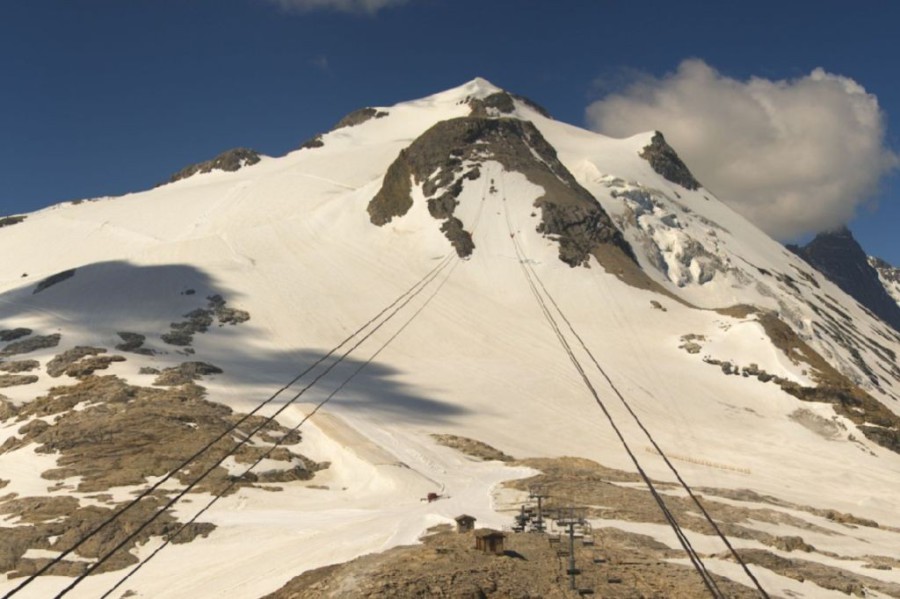 The Grande Motte glacier in Tignes pictured on 18 June 2026, before the summer heatwaves took their toll on the snow - Photo: tignes.net
In Switzerland, MétéoSuisse has confirmed that temperature anomalies were generally smaller in the high Alps and south-east of the country than across the Swiss lowlands, although exceptional heat was still recorded at altitude: Scuol, at 1304m, reached an all-time record of 35.1°C in June 2026, while a number of other Alpine stations also set temperature records during the summer.
Our analysis of MétéoSuisse's long-term temperature records shows that both Engelberg (at 1036m) and Davos (1594m) recorded their hottest summers since records began in 1864. At the much higher Jungfraujoch (3571m), summer 2026 was effectively in a dead heat with 2003 as the hottest since records there began in 1933.
 High temperatures in the Swiss Alps meant that snow conditions on the Saas-Fee glacier were less than ideal in summer 2026, with the resort eventually suspending operations on 10 August. This was how the ski area looked on 25 July - Photo: saas-fee.ch, 25
What did the extreme heat mean for the glaciers?
The consequences of the extreme heat in the Alps this summer have been impossible to ignore, not least in the rapid demise of summer skiing. A series of heatwaves that began in May and continued through June, July and August, combined with the preceding winter’s relatively modest snow conditions, left the high-altitude glaciers in an exceptionally vulnerable state.
Snow acts as a protective layer over glacier ice, reflecting much of the sun’s energy (the “albedo effect”). When it disappears, this leaves darker, older ice exposed, which absorbs more heat and accelerates the rate of melting.
 The loss of snow and appearance of the darker, older ice can clearly be seen in the August 2026 image of the Adamello glacier in Italy (on the right), contrasted with its appearance in August 2016 (on the left) - Source: European Union, Copernicus Sentine
One of the clearest indicators came on 29 June 2026, when according to Glacier Monitoring Switzerland (GLAMOS), Switzerland reached what is known as “Glacier Loss Day” – the point at which the mass accumulated during the previous winter has been effectively exhausted and further melting begins to eat into the glacier’s older ice. This was the second-earliest Glacier Loss Day on record in Switzerland, beaten only by 2022, when it occurred three days earlier, on 26 June. The significance of the shift in Glacier Loss Day is considerable.
Normally, Glacier Loss Day occurs considerably later in the summer, typically in around August. This year, however, the winter snow reserves had effectively been exhausted by the end of June, leaving potentially another three months during which melting could directly reduce the size of the glaciers themselves, rather than simply melting any leftover snow from the previous winter.
 Zermatt’s Theodul glacier on 30 August 1930 - Source: Glacier Monitoring Switzerland (GLAMOS)
 Zermatt’s Theodul glacier on 22 June 2022 - Source: Glacier Monitoring Switzerland (GLAMOS)
The summer the skiing stopped
The impact of the extreme heat was particularly dramatic on the remaining Alpine summer ski areas.
The number of Alpine summer ski areas has been declining for years due to climate change, but in summer 2026, by late July conditions had deteriorated to the point where even the highest and most established glacier areas were struggling to maintain viable and safe pistes.
Zermatt (which normally offers skiing 365 days a year) ended summer skiing on its Theodul Glacier on 31 July 2026, citing the combination of high temperatures, a lack of overnight cooling and deteriorating glacier conditions.
Saas-Fee shortly followed suit on 10 August 2026, leaving Italy’s Passo Stelvio as the last remaining summer ski area open in the Alps in August. However, this was also short-lived.
On 15 August 2026, Passo Stelvio also suspended its summer skiing operations due to persistent high temperatures, insufficient overnight refreezing and thunderstorms with high-altitude rain, which had further degraded the glacier.
For the first time in the modern history of Alpine summer skiing, for an extended period in August, there was consequently no summer skiing operating anywhere in the Alps.
 Italy’s Passo Stelvio - the last remaining ski area open in the Alps in Summer 2026 - pictured on 15 August 2026 when it closed due to poor snow conditions: Photo: pirovano.it, 15 August 2026
When the mountains themselves begin to change
Beyond skiing, the combination of prolonged heat, drought and thawing mountain permafrost has also made conditions increasingly hazardous for hikers, climbers and mountaineers.
Permafrost helps bind fractured rock together, so when it thaws, the stability of high-altitude rock faces can deteriorate, increasing the risk of rockfalls and larger collapses (of 100 cubic metres or more). This summer in the Alps, the effects have been particularly visible around the Mont Blanc massif.
Ludovic Ravanel, a geomorphologist and research director at France's National Centre for Scientific Research (CNRS), has described the exceptional number of rock collapses in the Mont Blanc massif as “one of the defining features” of summer 2026. He has predicted the number of collapses to reach around 400 this year – roughly 10 times more than 20 years ago, and considerably higher than the nearly 300 recorded during what he has described as the “catastrophic year” of 2022.
In August 2026, the risk of rockfalls became so severe on the normal French route up Mont Blanc that the Tête Rousse and Goûter mountain huts were temporarily closed due to major rockfall activity in the Goûter corridor, a notoriously dangerous gully used on ascents to the 4810m summit, with the closure effectively halting ascents by the normal route for a time. Although the huts did later reopen as conditions improved, there remained a significant risk of rock falls.
This August also saw the closure of the famous ice tunnel at the summit of the Aiguille du Midi (3842m), from which skiers and climbers access the Vallée Blanche and major climbing routes in the Mont Blanc range, after attempts to stabilise it failed. This followed the warmest July ever recorded at the Aiguille du Midi, with Météo France confirming that the monthly average temperature reached 3.3°C in July 2026, compared with 1.6°C in July 1994.
 The famous Aiguille du Midi ice tunnel in Chamonix, which was forced to close in August 2026 after attempts to stabilise it failed – Photo: OT Chamonix-Mont-Blanc
The potential consequences of this growing instability were demonstrated dramatically in Switzerland only last year, on 28 May 2025, when a huge rockfall onto the Birch Glacier triggered a catastrophic rock and ice avalanche that buried most of the evacuated village of Blatten in the Lötschental.
While the precise sequence of events was complex, subsequent research identified glacier retreat, reduced snow and ice cover and the degradation of mountain permafrost among the factors that contributed to the instability.
 Aftermath of the 28 May 2025 collapse of the Birch glacier, in Blatten-im-Lötschental, Switzerland – Source: European Union, Copernicus Sentinel-2 imagery, 30 May 2025
These kinds of events provide perhaps the most tangible illustration of what global warming means at high altitude in the Alps. The issue is not simply that there is less snow and less glacier ice, but that the physical structure of the mountains themselves is changing. As glaciers retreat, permafrost thaws and rock faces become increasingly unstable, the risks are not only felt by the ski industry but also by climbers, hikers, mountain guides and the communities and businesses that depend on Alpine tourism.
What was once regarded as a largely seasonal change in the mountains is increasingly becoming a year-round transformation, with consequences that extend far beyond the loss of a few weeks of summer skiing.
If you enjoy reading our updates - please feel free to support us:

 Print