


Where to ski in the Alps in November
by Fraser Wilkin, Updated: 2 November 2026
November is a transitional month for skiing in the Alps. At the beginning of November, skiing still mostly revolves around alpine glaciers, although some non-glacial terrain and even some entirely non-glacial ski resorts may also be open, albeit usually on a very limited basis and sometimes just at weekends, at least to start with.
As November progresses, more resorts begin to open, with the first major openings scheduled towards the end of the month. However, the extent of skiing available varies considerably from year to year, depending heavily on the weather.
In some years, the Alps can see big snowfalls to low altitudes early in November, or even in October, which greatly increases the chances of non-glacial terrain opening during November, sometimes ahead of schedule. However, there are often years when there is very little natural snow cover in November, even at higher altitudes, which can lead to scheduled openings being postponed, or the amount of skiing available being limited, especially in resorts without glaciers.
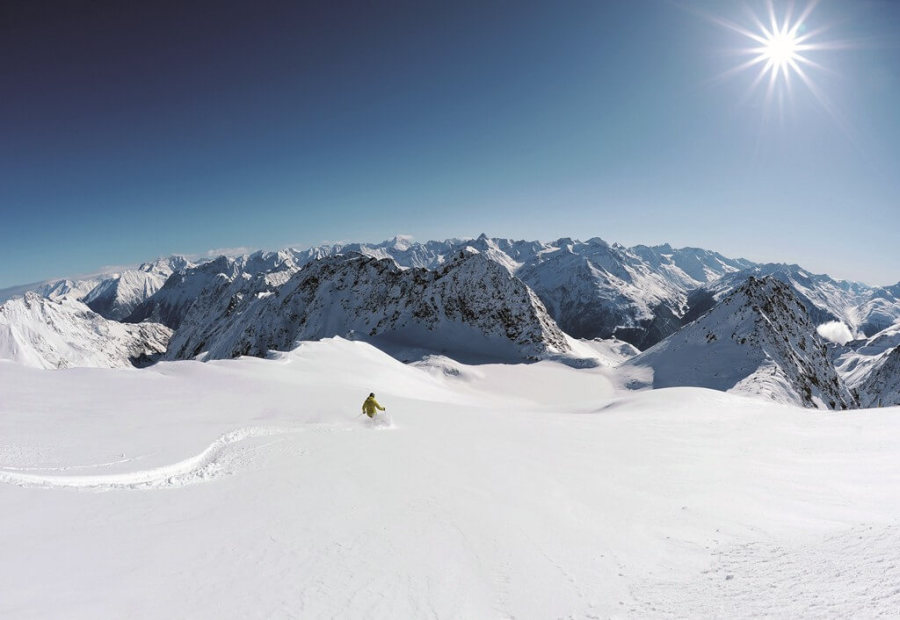 Sölden, Austria, is one of the best options for skiing in the Alps in November – Photo: Ötztal Tourismus / Isidor Nösig
What snow conditions can you expect in November?
Snow conditions in the Alps in November are highly variable. In a typical year, September and October will have already seen a few high-altitude snowfalls, but it is increasingly rare these days for any significant snow to have still stuck around by early November, at least below glacier level.
November itself sees a marked increase in the chance of significant snowfalls to lower levels but, with temperatures likely to still be yo-yoing, there is again no guarantee that any significant lower-lying snow will endure and provide a meaningful natural base.
However, November is also a month where many ski resorts start ramping up their artificial snowmaking, although this can be very temperature dependent, so snowmaking becomes more extensive towards the end of the month when typically lower temperatures allow it to become increasingly effective.
What is certain in November is that seeing “full-on” winter conditions with a widespread, lasting natural base to lower levels has become vanishingly rare in recent years.
To have the best chance of good snow conditions in the Alps in November, a ski area's altitude, quality and extent of snowmaking, and whether or not it offers access to a glacier, will all be important factors.
Is November a good time to ski in the Alps?
In early November, alpine skiing options are generally very limited in extent and mostly of interest to those happy with fairly restricted glacier terrain, like ski racers, technique camps and locals. However, even recreational skiers may be able to enjoy a short ski break in early November, especially if you are able to book at the last minute, snow conditions are good and the weather is playing ball.
Mid- to late-November is when options for ski holidays really start to open up, especially after a snowy autumn. A November ski holiday can offer quieter slopes and better value for money, but snow and weather conditions can be very variable, and it pays to research exactly when a resort is going to open (as they don’t always open to schedule) and just how much terrain will actually be available.
So, how are snow conditions shaping up for November 2026?
As we enter November 2026, snow conditions are unremarkable either way.
October saw a few small and mostly high-altitude snowfalls across the Alps followed by a more consequential dump later in the month. This markedly improved snow conditions on the glaciers, which had been in an exceptionally poor state well into October after the record-breaking summer heat.
While much of the lower-lying snow from the late October storm has now melted, enough has survived at high altitude to provide reasonable conditions on the glaciers, even if dry weather as we enter November means that the pistes are becoming increasingly hard-packed and icy.
Where can you ski in the Alps in November?
Early in November, there may be up to two dozen or so skiing options open across the Alps. Many of these will still revolve around glaciers, although a number of non-glacial options are also normally open, even if sometimes only at weekends to begin with.
Not all the early-November options will necessarily be at particularly high altitude. If demand is high (for example, where a ski area is close to large population centres) even quite low ski resorts will use snowmaking and/or snow farming to open some runs early in the month.
During the second half of November, there is normally a major ramping-up of skiing activity across the Alps, with the first wave of “serious” resort openings including major high-altitude resorts or areas with enough skiing available to warrant consideration for a proper multi-day ski holiday. However, the number of options and extent of skiing open is still variable year on year.
At the the time of writing (2 November 2026) up to 16 or so ski areas are operational across the Alps depending on the exact day of the week. Some are only open at weekends or on specific days. However, more ski areas are likely to open soon, even if more snow is awaited.
Here we look at the typical November options in the Alps, country by country:
Austria
Austria traditionally offers the greatest number of ski options in November, partly because it has the most skiable glaciers (including Hintertux, Sölden, Stubai, Pitztal and Kitzsteinhorn). This is also due to its more continental climate which, being slightly cooler and less humid than further west, is more conducive to snowmaking, meaning that some relatively low resorts (e.g. Schladming and Kitzbühel) may also open on a largely artificial base.
Even in a modest early snow year, Austria historically boasts some big-name ski resort openings during the second half of November, including Obergurgl (the first major entirely non-glacial opening in the Alps), Obertauern and, most notably, Ischgl, which often offers the greatest extent of skiable terrain in the Alps in late November.
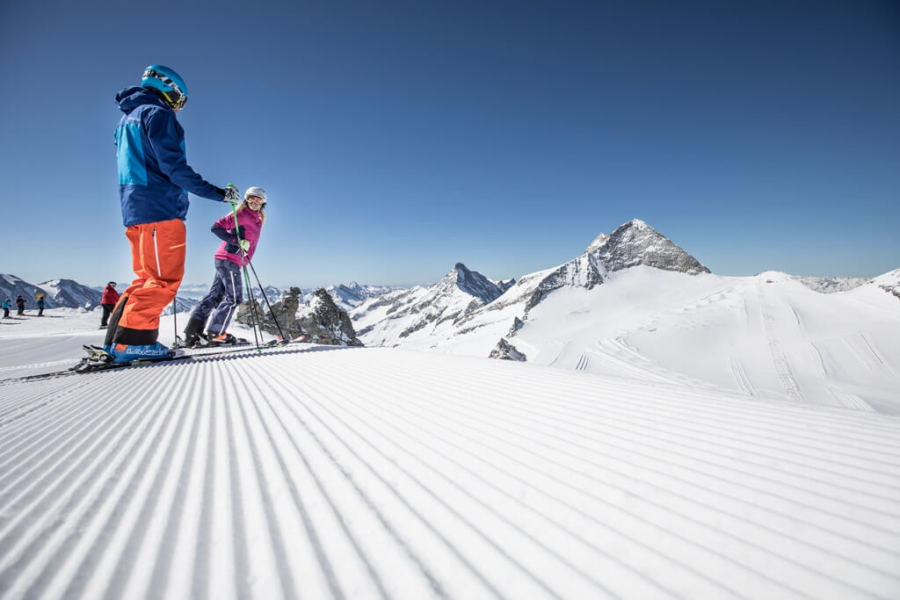 Hintertux glacier, Austria – Photo: Hintertux Gletscher
France
France historically offers the least skiing options in the Alps in November, with very few (if any) ski areas open in early to mid-November, unless snow conditions are exceptional, when some resorts may go for an impromptu, unscheduled early (and probably at-weekends-only) opening.
More commonly, though, you will have to wait until the third week of November for any significant French options, with Val Thorens usually the first major French ski resort to open.
Other big-name French resorts opening in late November, and which offer any serious amount of terrain, include Tignes, Val d’Isère and Les 2 Alpes. A handful of other, more limited options may also open, including Montgenèvre and Chamonix.
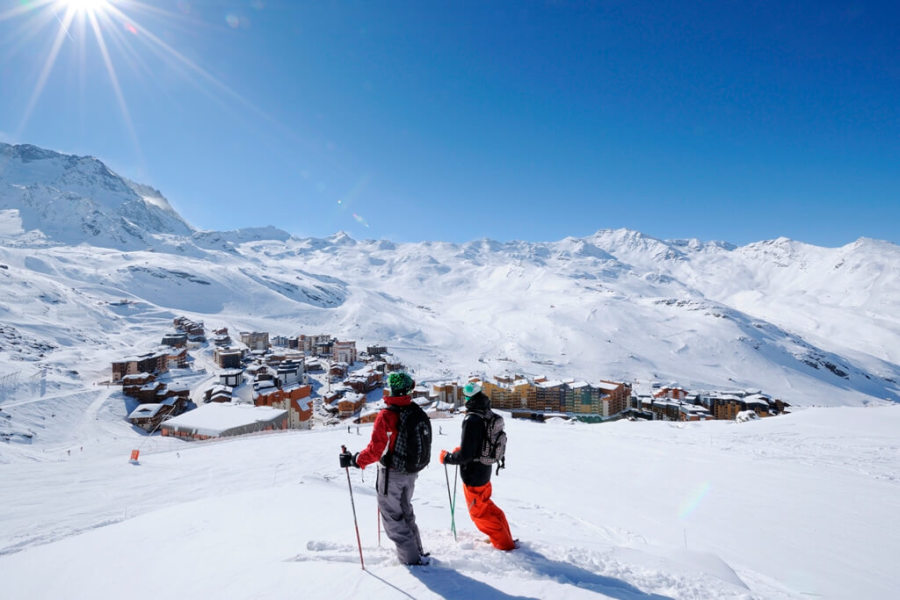 Photo: OT Val Thorens, P Lebeau
Italy
Skiing options in Italy in early November are very limited, with Cervinia normally the country’s stand-out ski area. If it hasn’t snowed much in October or November, you may find yourself limited to the glacier (shared with Zermatt, most of which is on the Swiss side) but in some years you may already be able to ski below glacier level to Cime Laghi Bianchi (2812m) or, if you are very lucky, even down to Plan Maison (2545m).
With the glacier at Passo Stelvio closing in early November (opening only during summer/early autumn), the only other early Italian November skiing options are usually on the glacier at Val Senales, or at the entirely non-glacial, but quite limited, Sulden-am-Ortler.
Later in November, more skiing options open up in Italy, especially at the end of the month when many Dolomite resorts get going (often thanks to their world-class snowmaking). This region then offers some of the most extensive skiing in the Alps in late November.
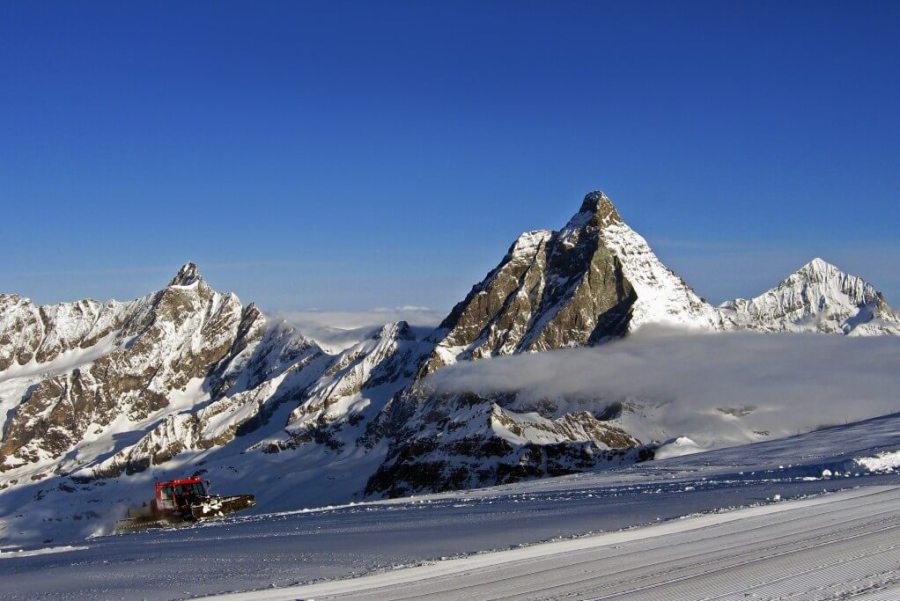 Cervinia, Italy, with the Matterhorn in the background
Switzerland
Right at the start of November, Switzerland’s skiing options still mostly revolve around glaciers. The best-known, and usually most extensive, are Zermatt and Saas-Fee. However, smaller ones like Engelberg’s Titlis glacier, and the Diavolezza glacier near St Moritz, are usually also open (although the latter only 3 days a week).
More glacial and non-glacial options open up early in November, including the likes of Glacier 3000, Davos-Klosters, Arosa-Lenzerheide and Verbier, but still on a very limited basis.
The number of Swiss skiing options continues to increase through mid- and especially late-November, by which time a couple of dozen ski resorts may be open, including Wengen-Grindelwald, Laax and Crans-Montana, to name just a few.
In most years, the extent of open terrain in any one area will remain quite limited in November. However, in good years, resorts such as Zermatt may open some more extensive terrain by the end of the month.
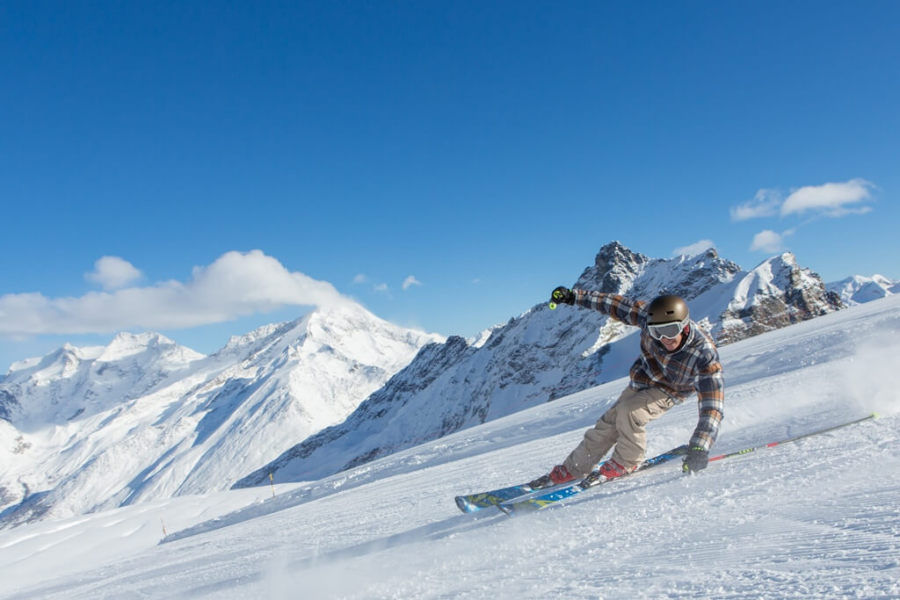 Skiing in Saas-Fee, Switzerland

Where are the best places to ski in the Alps in November 2026?
When choosing where to ski in November, it is important to distinguish between resorts offering only a handful of glacier runs and those likely to have enough terrain open to make for a worthwhile multi-day ski holiday. The number of options for the latter increases considerably towards the end of November, although the extent of skiing available remains highly dependent on the weather.
Generally speaking, the most reliable ski areas in the Alps in November in terms of both snow conditions and extent of open terrain are:
By early November:
- Hintertux (open from )
- Zermatt (open from )
- Saas-Fee (open from )
- Sölden (glacier open from , main ski area scheduled to open )
- Kitzsteinhorn, Kaprun (open from )
- Other glacier areas worth considering (until bigger options open up later in November) include Stubai (open from ), and Pitztal (open from )
By mid-November:
- Obergurgl (scheduled to open )
- Obertauern (scheduled to open partially from then fully from )
By late November:
- Ischgl (scheduled to open )
- Tignes (scheduled to open , with Tignes–Val d'Isère ski area from )
- Val Thorens (scheduled to open from - with 3 Valleys opening from )
- Some Dolomites resorts (e.g. Kronplatz - scheduled to open )
Scheduled opening dates are subject to snow and weather conditions. In some cases, particularly on the glaciers, only limited terrain may initially be available.
If you enjoy reading our updates - please feel free to support us:
 Print