weathertoski.co.ukIn-depth review of the 2025–26 ski season in
the Alps and Europe, revealing which resorts saw the most snowfall — by Fraser Wilkin.
The 2025–26 Alpine winter ski season was defined by very mild temperatures and generally limited snowfall across the Alps.
The main exceptions were in France, where seasonal snowfall totals were a bit closer to normal, and in some areas even a little above (e.g. Tignes, Isola 2000).
The far western and especially south-western Italian Alps also did well, with a notably snowy season for both Prato Nevoso and Limone Piemonte. For the vast majority of the Alps, however, snowfall
totals were very modest.
Courmayeur was one of the snowier Italian resorts during the 2025-26 winter ski season – Photo: Argiland via facebook.com/montagnaneveski.info, 10 February 2026
But modest snowfall does not necessarily mean poor skiing conditions.
Thanks in large part to extensive snowmaking, on-piste snow cover was rarely an issue even in those ski resorts which saw meagre snowfall, at least during the core part of the season. Rainfall was
also less disruptive than in many recent winters.
Sunshine was also in plentiful supply throughout the season, particularly in the central and eastern Alps (at least above any low cloud trapped during some very persistent temperature
inversions).
Taken together, these factors meant that, for piste-skiers at least, snow and skiing conditions during the 2025–26 Alpine ski season were better than you might think in the areas that didn’t see
much snow.
Modest snowfall doesn’t necessarily mean poor skiing. This is Turracher Höhe in the southern Austrian Alps in January, where the pistes remained in good conditions despite a relative lack of snow – Photo: foto-webcam.eu, 30 January 2026
For off-piste skiers, however, the 2025–26 ski season was a challenging one for the Alps. The central and eastern Alps experienced very few powder days and, while the western Alps (particularly
the French Alps and the far western Italian Alps) saw more snowfall, this came with two major drawbacks.
Firstly, due to an early snowfall being followed by a prolonged cold and dry period, a persistent weak layer had formed within the snowpack early in the winter. As subsequent snowstorms deposited
snow on top of this weak layer, it remained poorly bonded, creating an unstable snowpack that was prone to collapse.
Secondly, snowfall across much of the western Alps was highly erratic, with some of the largest accumulations occurring over short periods in January and, especially, in February. For chronological context: ; . These intense snowfall events rapidly increased the load
on the already unstable snowpack, further elevating the risk of avalanche.
Together, these factors contributed to a high number of avalanche incidents across the French, western Swiss, and western Italian Alps, with off-piste skiing too dangerous or off limits in these
regions.
Lots of snow fell in the western Italian Alps in mid-February, but the avalanche danger was sky-high. This is Rhêmes in the Aosta valley – Photo: Meteo Valle d’Aosta, 19 February 2026
All things considered, the most consistently favourable snow conditions of the 2025–26 Alpine ski season were in the far southern French Alps, where Isola 2000, for example, enjoyed regular but
manageable snowfall throughout the season.
This steady pattern produced reliable snow conditions without the prolonged dry spells or intense snowfall events that affected other parts of the Alps.
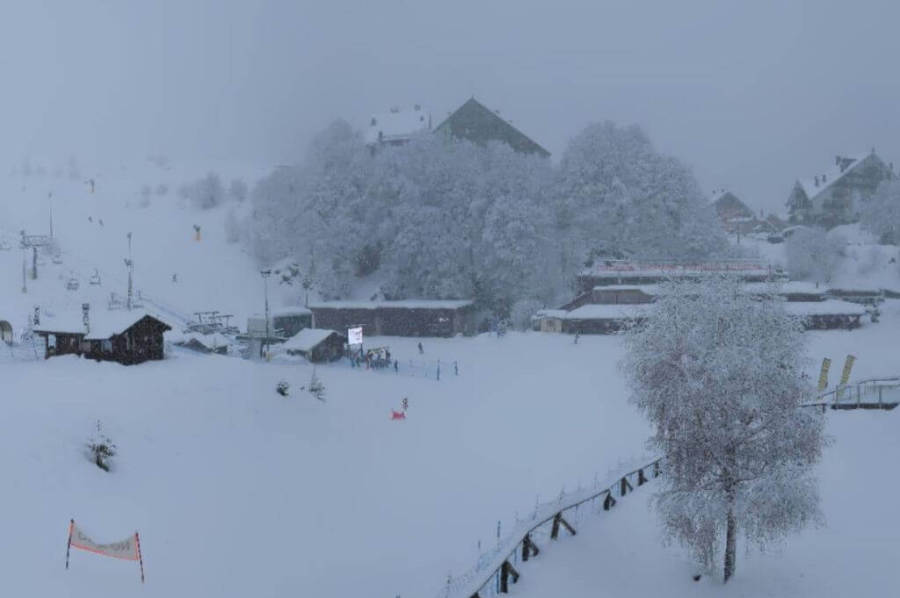
Auron, near Isola 2000 in the far southern French Alps, had an excellent season – Photo: auron.com, 28 January 2026
A retrospective of the 2025-26 ski season in the Alps
A detailed review of the 2025-26 ski season in the Alps, covering monthly snowfall totals, notable weather events, snow conditions at key ski
resorts, and how the season evolved across different Alpine regions. Includes analysis of snow reliability, high-altitude and glacier areas, and the impact of weather patterns on resort operations
and skiing quality throughout the season.
After a largely unremarkable autumn, snow conditions in the Alps improved significantly towards the end of October, For chronological context:
. thanks to a major storm cycle that brought more than a metre of snow at altitude to parts of the north-western Alps.
This was followed by further top-ups at the end of OctoberFor chronological context: . and into
earlyNovember, For chronological context: . leaving many higher ski areas with
above-average snow depths for the time of year.
The biggest snow accumulations from these late October For chronological context: . and early November For chronological context: . snowfalls were recorded in the northern French Alps, particularly in the Tignes-Val d’Isère ski area (formerly known as Espace Killy), where more than a metre of snow fell in
late October.
Several other high-altitude resorts also managed to develop decent early-season bases, at least at altitude, including Val Thorens, Verbier, Cervinia, Ischgl and Obergurgl.
As November progressed, For chronological context: . a drier and warmer period ensued before
further snowfalls reached the Alps later in the month. These became increasingly significant during November, particularly in the north-western Alps. Indeed, lower-altitude areas, including Megève and the Portes du Soleil, recorded their deepest November snow since 1996.
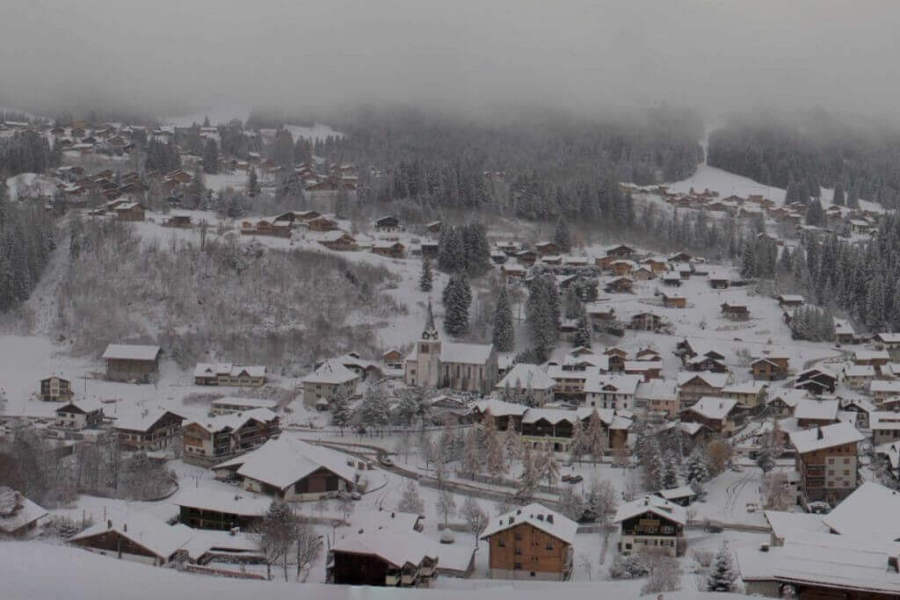
Les Gets saw promising pre-season snowfalls in late November 2025 – Photo: lesgets.com, 20 November 2025
Unfortunately, DecemberFor chronological context: . ended up being very dry and mild, gradually
undoing all the good work from earlier in the season. By the third week of December, even the previously snow-rich north-western Alps saw snow depths fall back below average for the time of year.
Elsewhere in the Alps, where less snow had fallen in November, For chronological context: . snow depths became very
meagre, though there was still plenty of good skiing on offer, helped by largely fine weather and extensive snowmaking.
One exception to the dry December For chronological context: . was the far south-western Alps, where the second half
of the month proved to bring very snowy conditions, with some extreme snowfall totals in the southern Piedmont resorts of Limone and Prato Nevoso. This included accumulated snowfall of 150cm in a
24-hour period on 23 December in Prato Nevoso, which had settled snow depths of 3m over Christmas up top.
Prato Nevoso, in the far south-western Italian Alps, saw several exceptional snowfalls in December 2025 and January 2026 – Photo: pratonevoso.com, 22 December 2025
Aside from in the far south-west, New YearFor chronological context: New Year 2025–26, spanning December 2025 and January 2026. snow conditions
across the Alps were less than ideal, with plenty of hard-packed and even icy pistes, particularly in the lower resorts of Austria and eastern Switzerland.
The weather finally broke about a week into January, For chronological context: . after six weeks
with hardly any snowfall in the Alps away from the south-west. A major storm cycle delivered significant snow to many Western Alpine regions, particularly France. Further east, the snowfalls were not
quite as potent but, excepting the Dolomites (where snowmaking was keeping the pistes in good shape), most areas also received a useful top-up.
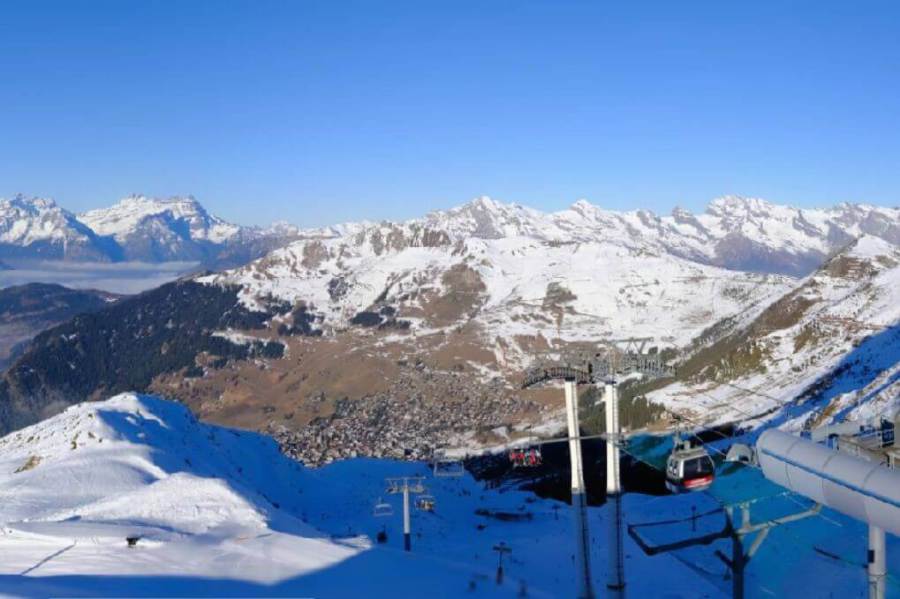
The December snow drought became very evident on the lower ski slopes of Verbier over New Year 2025 – Photo: verbier.ch, 31 December 2025
During the middle of January, For chronological context: . the storm-track once again favoured the
south-western Alps, with snow depths remaining exceptional in the southern Piedmont, particularly around Prato Nevoso. The weather across the Alps then became generally more unsettled towards the
end of January, but continued to favour the western Alps, where mid-winter snow depths were relatively healthy.
For most of the rest of the Alps, however – including the Swiss Alps away from the far west, the Italian Alps away from the far west, and Austria as a whole – late-January snow depths remained
well below the seasonal average. For chronological context: .
Early FebruaryFor chronological context: . saw the southern Alps take the lion’s share of the
fresh snow, although this time the benefits extended beyond the south-west. Snow depths in the Dolomites also improved significantly, just in time for the 2026 Winter Olympics.
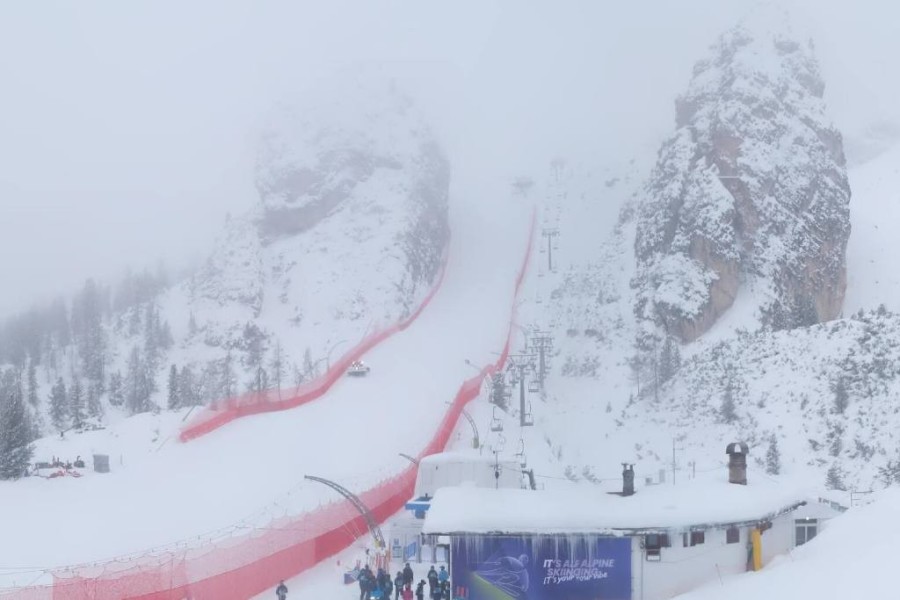
Cortina saw plenty of snow in early February in the run up to the 2026 Winter Olympics – Photo: cortina.dolomiti.org, 5 February 2026
Just before February half term, For chronological context: . another major storm affected the whole
of the western Alps, particularly France, with exceptional snowfalls continuing across these western regions throughout much of the holiday week itself.
Some French ski resorts, including those in the Portes du Soleil, saw virtually no sunshine until the very end of the week, while multiple, large, spontaneous avalanches were reported across many
parts of France, western Switzerland and western Italy.
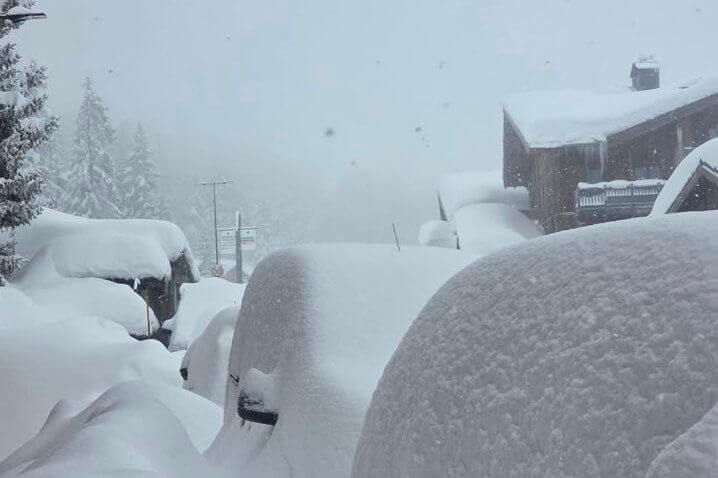
Too much snow in the western Alps for some over February half term! This was La Rosière in the French Alps, which saw almost no sun all week – Photo: Amoureux de La Rosiere, 16 February 2026
In many ways, the snow and weather conditions over half term were better suited to families enjoying their February half term ski holidays further east. For
chronological context: . In Austria, for example, there was plenty of good piste-skiing despite low overall snow depths and little disruption from
the heavy snowfalls seen further west.
Later in February, For chronological context: . temperatures rose sharply across the Alps. Although
there was some fresh snow for higher ski resorts in the north-eastern Alps, including Obertauern, most regions enjoyed plenty of sunny weather,
meaning that spring skiing conditions arrived early.
MarchFor chronological context: . then began mostly dry and relatively mild, with spring snow
conditions at lower elevations, and the best snow conditions to be found in the higher ski resorts of the western Alps, particularly in France.
By mid-March, For chronological context: . some significant snowfall reached the western Alps, though
temperatures never became particularly cold, and freeze-thaw conditions quickly returned to most areas, especially at lower elevations.
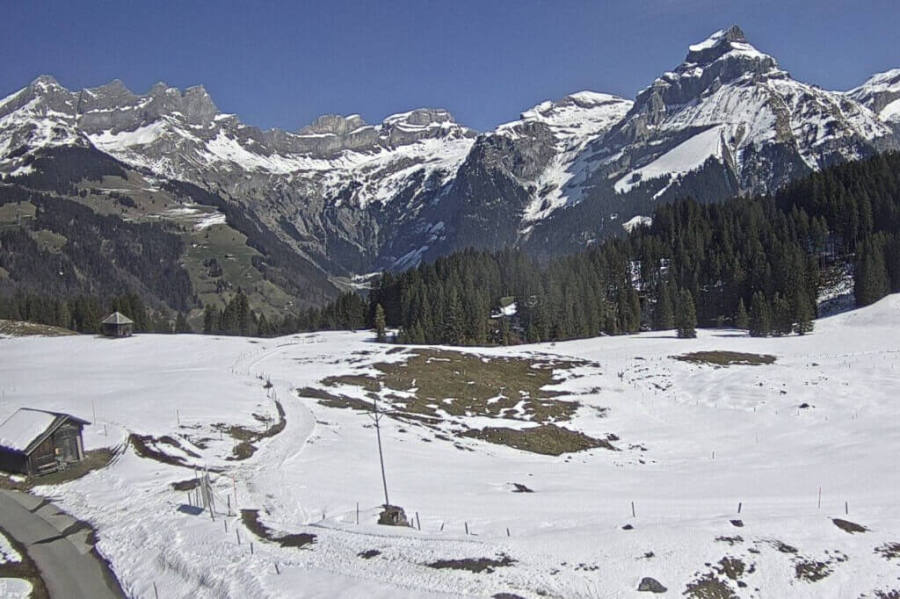
Spring snow conditions in Engelberg in mid-March 2026 – Photo: engelberg.ch, 20 March 2026
The end of MarchFor chronological context: . then brought much colder weather to the Alps, with
significant snowfall reaching low altitudes across much of the northern Alps, particularly in Switzerland and Austria, while the southern Alps largely missed out.
Apart from some snow in the south-western Alps during the middle of the month, AprilFor chronological context: . was exceptionally dry in the Alps. It was also very warm during the first part of the month, although became somewhat cooler later on.
For the higher ski resorts in the Alps, including Val d’Isère, Tignes, Val Thorens, Cervinia and Zermatt, April offered
some wonderful on-piste snow conditions in almost unbroken sunshine. For chronological context: . Lower down though, snow
conditions deteriorated rapidly under the increasingly strong spring sun.
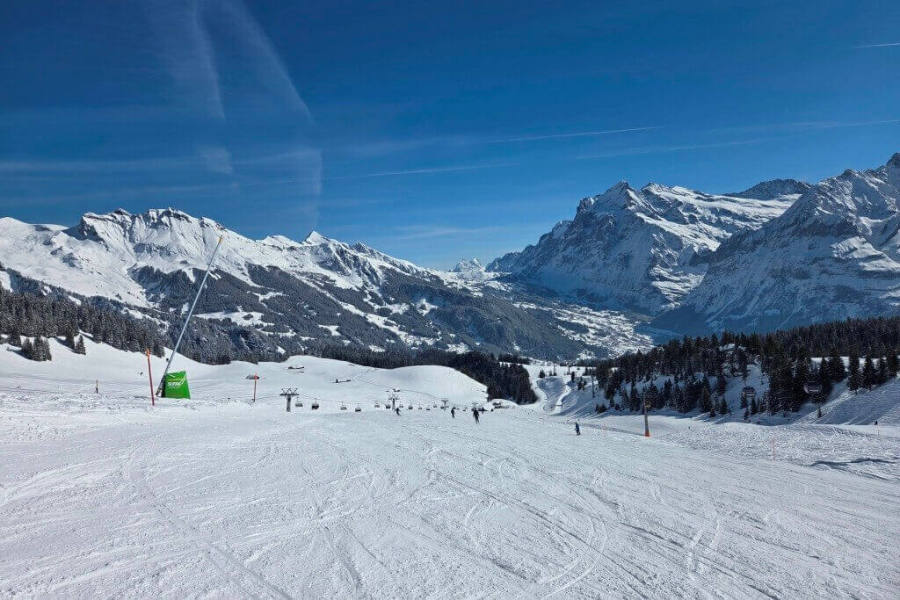
Late March snow conditions were excellent in Wengen, in the northern Swiss Alps – Photo: weathertoski.co.uk, 28 March 2026
So who got the most snow in the Alps in 2025-26?
A detailed analysis of the 2025-26 ski season snowfall across ski resorts in Europe and the Alps, highlighting stand-out ski resorts with the
highest snowfall totals. Includes the final ranking of which resort received the most snow, as well as caveats about the reliability of accumulated snowfall data across Europe due to variations in
measurement methods and reporting.
First - a few words of caution regarding snowfall statistics in the Alps!
Unlike in the US, there is no real culture for collecting and comparing snowfall data in ski resorts on this side of the pond, with even less standardisation. Although a number of snowfall
figures are available, with a bit of digging, many of these are measured at resort level which means they are unlikely to be indicative of the ski area as a whole.
This point is of particular importance in ski seasons when the weather is changeable but mild, and where frequent low-level rain can lead to greater than normal discrepancies in cumulative
snowfall totals from the top to bottom of a ski area.
It is also important to remember that snowfall averages are only one aspect of the overall 'snow quality equation' and should certainly
not be regarded as the most important factor when assessing snow reliability in any given ski resort.
On the whole, the most impressive snowfall totals of the 2025-26 Alpine ski season were in the higher ski resorts of the French Alps, especially in the Tarentaise valley, where Val d’Isère clocked 567cm at resort level (1850m) and Tignes totalled just over 6m at 2100m, close to
their long-term averages in both cases. Further south, Isola 2000 saw 480cm at resort level, a fraction above its long-term average.
In Switzerland, snowfall totals were universally below average, although much less so in the west, with around 300cm at resort level (1500m) and 563cm at 2200m in Verbier, compared with a long-term average of around 600cm.
Further east, Davos (1560m) only managed a modest 251cm versus its long-term average of just over 400cm.
In Italy, Courmayeur saw 496cm at 1700m, roughly what you would expect in an average ski season. However, further east, in the Dolomites,
Arabba only managed 246cm, a significant drop compared to its long-term average of 3.7m.
Most of Austria had a very lean 2025-26 ski season, with just 1.8m at 1600m in the Kitzbühel and SkiWelt areas, where long-term averages are closer to 5m.
Seasonal snowfall totals in the super-snowy Vorarlberg area were also below par but, as is often the case, this did not stop Warth-Schröcken
taking the title of “snowiest ski resort in the Alps” in 2025-26 (at or close to resort level) with 753cm at 1675m.
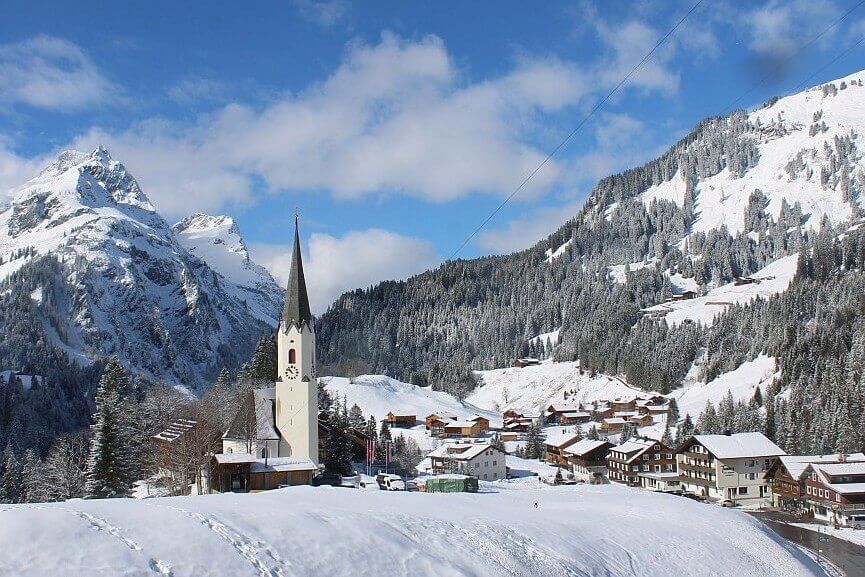
Warth-Schröcken once again takes the title of “Who got the most snow in the Alps” for 2025-26, at resort level at least. This was Schröcken during the 2026 February half term school holidays – Photo: warth-schroecken.at, 15 February 2026
As we are always at pains to point out, you should not read too much into snowfall totals in terms of the overall ‘qualitative’ skiing experience in any given ski resort.
If we were to give a title for the ski resort or region with the “best skiing conditions in the Alps” during the 2025-26 ski season, that award would go to the southern French
Alps, and particularly to Isola 2000.
Despite seeing only just above its long-term average snowfall, Isola 2000 enjoyed some of the most consistently favourable skiing conditions in the Alps in 2025-26, having what officials described
as “the perfect season”: a combination of frequent but not disruptive snowfalls “at all the right times”, as well as plenty of sun!






 Print
Print